





Commercial EV Charging as Business Energy Infrastructure
Commercial EV charging is rapidly becoming an important part of long-term business infrastructure planning.
As electric vehicle adoption increases, many organisations are reviewing how charging infrastructure can support employees, fleet vehicles, customers, visitors and future operational requirements.
While EV chargers are often viewed as standalone assets, the most effective commercial charging installations are designed as part of a wider site energy strategy.
Commercial EV charging infrastructure can influence electricity demand, operational flexibility, site capacity planning and future energy investment decisions.
For many businesses, commercial EV charging may support:
- Workplace charging
- Fleet electrification
- Visitor charging
- Customer charging
- Operational electrification
- Business sustainability goals
- Future expansion planning
- Long-term energy management
Supporting long-term business electrification
As businesses become increasingly reliant on electric vehicles, charging infrastructure needs to support both current requirements and future growth.
Employee charging, fleet electrification, customer charging and operational transport all place different demands on site infrastructure.
Bespoke PV designs commercial EV charging systems around operational requirements, future scalability and wider energy planning, helping businesses avoid short-term decisions that may restrict future flexibility.
Why Businesses Are Investing in Commercial EV Charging
Businesses are increasingly investing in EV charging infrastructure for operational, commercial and sustainability reasons.
Electric vehicle adoption continues to grow across company fleets, employee vehicles and customer transport, creating new expectations around charging availability.
Commercial EV charging can help businesses support workplace charging requirements, prepare for fleet electrification, improve customer experience and contribute towards wider sustainability objectives.
The value of a commercial charging installation will depend on how the business operates, who requires access to charging, available electrical capacity and future expansion plans.
Potential benefits may include:
- Supporting fleet electrification
- Providing workplace charging
- Improving customer experience
- Supporting sustainability goals
- Preparing for future EV adoption
- Improving operational flexibility
- Enhancing site attractiveness
Commercial EV charging as a strategic investment
For some organisations, the primary driver is supporting employee charging. For others, fleet electrification, customer charging or sustainability objectives may be the main consideration.
Increasingly, businesses are viewing EV charging as part of a wider operational strategy that includes renewable energy generation, battery storage, electrification and long-term energy management.
A properly designed commercial EV charging system should therefore be planned around future requirements as well as immediate demand.
Beyond Charger Installation: Whole-Site Energy Planning
One of the most common mistakes in commercial EV charging projects is focusing solely on charger installation without considering the wider site infrastructure.
Charging demand can have a significant impact on electrical capacity, load profiles and future energy requirements.
As charging infrastructure expands, businesses increasingly need to consider how EV charging interacts with existing electricity demand, solar PV systems, battery storage and operational activities.
A whole-site approach can help ensure charging infrastructure remains scalable, efficient and aligned with long-term business objectives.
Depending on the site, commercial EV charging planning may involve:
- Electrical capacity assessment
- Load management
- Solar PV integration
- Battery storage compatibility
- Future charger expansion
- Demand forecasting
- Operational energy planning
Creating a flexible charging strategy
The most successful commercial EV charging projects are designed around how vehicles, people and energy interact across the site.
This can help businesses avoid unnecessary infrastructure upgrades, improve charger utilisation and create a charging strategy that remains effective as vehicle adoption increases.
Bespoke PV approaches commercial EV charging as part of wider business energy planning rather than simply installing charging hardware.
Business Types We Design Commercial EV Charging For
Different organisations use EV charging infrastructure in different ways. Bespoke PV designs commercial charging systems around operational requirements, user behaviour, electrical capacity, future expansion plans and wider energy strategy.


Workplaces & Offices
Workplace charging can help businesses support employees, attract talent, meet sustainability objectives and prepare for increasing EV adoption among staff and visitors.

Fleet Operators
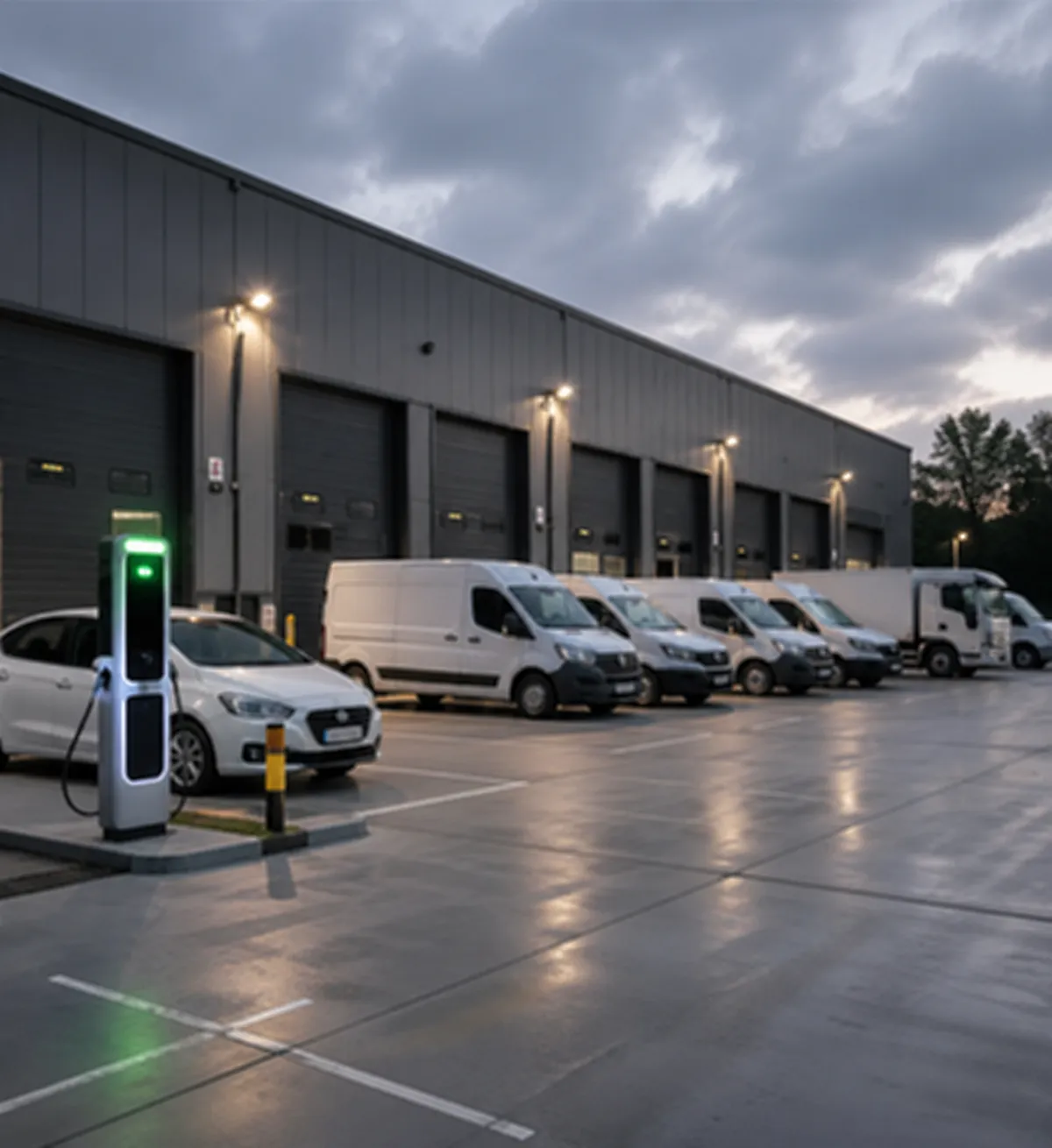
Fleet charging infrastructure can support electric vans, cars and operational vehicles while helping businesses plan for long-term fleet electrification.


Industrial & Manufacturing Sites
Industrial premises may require charging systems designed around operational demand, shift patterns, fleet charging requirements and electrical capacity management.


Warehouses & Distribution Centres
Distribution facilities can benefit from EV charging infrastructure designed around fleet operations, logistics planning, delivery schedules and future electrification requirements.


Hospitality & Visitor Destinations
Hotels, hospitality venues and visitor destinations may use EV charging to improve customer experience, support sustainability goals and attract EV-driving visitors.

Vehicle Depots & Service Fleets
Vehicle depots, service fleets and operational transport hubs may require charging infrastructure designed around vehicle availability, charging windows, operational schedules and future electrification.
Workplace EV Charging
Workplace EV charging is becoming an increasingly important consideration for businesses as more employees switch to electric vehicles.
Providing charging facilities can help organisations support staff, improve convenience and prepare for continued growth in EV adoption.
For many businesses, workplace charging is also becoming part of wider sustainability and employee wellbeing strategies.
A successful workplace charging installation should consider how employees use the site, expected charging demand, available electrical capacity and future growth.
For many organisations, workplace charging is becoming part of a wider employee benefits and workplace sustainability strategy. As electric vehicle ownership increases, employees increasingly expect charging facilities to be available during the working day. Businesses that provide charging infrastructure can help improve convenience while supporting wider environmental objectives. The level of workplace charging required will vary depending on staff numbers, site usage patterns, available electrical capacity and future growth plans.
Workplace charging may help organisations:
- Support employee EV adoption
- Improve workplace facilities
- Prepare for future demand
- Support sustainability goals
- Attract and retain staff
- Provide charging flexibility
Planning workplace charging for future demand
Many businesses initially install only a small number of chargers before demand increases significantly over time.
Planning infrastructure with future expansion in mind can help avoid unnecessary disruption and additional costs later.
Bespoke PV helps businesses assess charging demand, user behaviour and future growth plans to create workplace charging systems that remain effective as adoption increases.
Fleet Charging and Operational Electrification
Fleet electrification is becoming a major driver of commercial EV charging investment.
Many organisations are transitioning company cars, service vehicles, vans and operational fleets to electric power as part of wider sustainability and operational efficiency programmes.
Fleet charging infrastructure needs to be designed around vehicle usage patterns, charging windows, operational requirements and future fleet growth.
As fleet electrification progresses, charging infrastructure increasingly becomes part of wider operational planning rather than a standalone facility.
Fleet electrification presents different challenges to workplace charging because charging demand is often linked directly to operational requirements. Vehicle availability, route planning, overnight charging windows, daily mileage and future fleet growth can all influence charging infrastructure design. For organisations operating service fleets, delivery vehicles or operational transport, charging infrastructure increasingly forms part of wider business continuity and operational planning.
Commercial fleet charging may support:
- Electric company vehicles
- Service fleets
- Operational vehicles
- Delivery fleets
- Fleet electrification strategies
- Long-term transport planning
- Operational efficiency improvements
Supporting long-term fleet transition
As vehicle fleets become increasingly electrified, charging infrastructure must be capable of supporting both current and future operational requirements.
This may include additional chargers, load management systems, battery storage integration and solar-supported charging strategies.
Bespoke PV helps businesses create scalable fleet charging infrastructure that supports operational flexibility while preparing for future growth.
Visitor, Customer and Destination Charging
For many organisations, EV charging is not only about supporting employees or operational vehicles.
Customer charging, visitor charging and destination charging can also form an important part of the overall business offering.
Hotels, leisure facilities, retail destinations, visitor attractions and customer-facing businesses are increasingly providing charging facilities to improve convenience and meet changing visitor expectations.
Well-designed charging infrastructure can support customer experience while contributing towards wider sustainability objectives.
Businesses are increasingly recognising that EV charging can influence customer choice, visitor satisfaction and destination attractiveness. As EV ownership continues to grow, charging infrastructure may become an expected facility rather than a differentiator for many customer-facing organisations.
Commercial charging systems may be designed to support:
- Visitor charging
- Customer charging
- Destination charging
- Public-facing charging
- Hospitality charging
- Leisure and tourism charging
- Future charging expansion
Creating value through charging accessibility
As EV adoption increases, businesses that provide convenient charging facilities may become more attractive to customers, visitors and guests.
Charging infrastructure can also support longer dwell times, improve visitor convenience and help organisations demonstrate commitment to sustainability.
Bespoke PV designs customer-facing charging infrastructure around operational requirements, visitor behaviour and long-term business objectives.
Solar PV, Battery Storage and EV Charging
Commercial EV charging can become significantly more effective when planned alongside solar PV and battery storage.
Rather than viewing charging infrastructure as a standalone electrical load, many organisations are now integrating EV charging into wider renewable energy and energy management strategies.
Solar PV can help provide on-site renewable electricity during the day, while battery storage can increase flexibility by storing surplus generation or lower-cost imported electricity for later use.
This integrated approach can help improve energy efficiency, increase solar self-consumption and create greater control over charging demand.
Battery storage can also help reduce the impact of EV charging on site electrical infrastructure by allowing stored energy to be used when charging demand is highest. This can improve flexibility while supporting greater use of on-site renewable generation.
Commercial renewable energy integration may support:
- Solar-supported charging
- Battery-assisted charging
- Improved solar self-consumption
- Reduced imported electricity
- Operational flexibility
- Integrated energy management
Creating a joined-up energy strategy
The strongest long-term outcomes are often achieved when EV charging, solar generation and battery storage are considered together.
This can help businesses optimise how electricity is generated, stored and used across the site while preparing for future electrification.
Bespoke PV designs integrated renewable energy systems that align EV charging infrastructure with wider operational and energy objectives.
Load Management, Electrical Capacity and Future Expansion
Electrical capacity is one of the most important considerations in commercial EV charging design.
Installing multiple chargers without understanding existing site demand can create operational constraints, trigger unnecessary infrastructure upgrades or limit future expansion opportunities.
Load management technologies allow charging demand to be controlled intelligently, helping businesses make better use of available electrical capacity.
As EV adoption increases, planning for future charger growth becomes increasingly important.
For many businesses, electrical capacity becomes the limiting factor rather than charger quantity. Load management systems can dynamically adjust charging behaviour based on available site capacity, helping multiple vehicles charge without exceeding infrastructure limits. This can reduce the need for costly electrical upgrades while improving overall charging flexibility.
Commercial EV charging projects may require consideration of:
- Electrical capacity assessment
- Load balancing
- Future charger expansion
- Demand management
- Infrastructure planning
- Operational flexibility
- Grid connection considerations
Planning infrastructure for future growth
The number of electric vehicles using a site may increase significantly over time.
A charging system designed purely around current requirements may not provide sufficient flexibility as vehicle adoption accelerates.
By considering future growth at the design stage, businesses can create infrastructure that remains scalable, efficient and cost-effective.
As transport, energy generation and electricity consumption become increasingly connected, commercial EV charging is evolving from a standalone facility into a core part of wider business infrastructure. Organisations that plan charging strategically today are often better positioned to support future vehicle adoption, operational growth and wider electrification objectives.
Bespoke PV assesses site capacity, projected charging demand and future operational requirements before recommending commercial charging infrastructure.
Monitoring, Access Control and Charging Visibility
Modern commercial EV charging systems provide far more than simple charging functionality.
Monitoring platforms and management software can provide valuable visibility into charger performance, utilisation and electricity consumption.
This information can support operational decision-making, charging policy development and long-term infrastructure planning.
Depending on operational requirements, businesses may also implement access controls, user management and charging permissions.
Commercial charging platforms may provide visibility into:
- Charging behaviour
- Electricity consumption
- Charger utilisation
- User access
- Solar charging contribution
- Operational demand
- Long-term charging trends
Using charging data to improve performance
Charging visibility makes it easier to understand how infrastructure is being used and whether charging assets are supporting wider business objectives.
Monitoring can help identify opportunities to improve utilisation, refine charging policies, plan future expansion and optimise energy use.
Bespoke PV supports businesses with system setup, monitoring advice and long-term charging infrastructure planning.
Net Zero, ESG and Business Sustainability
Commercial EV charging can contribute towards wider sustainability, ESG and Net Zero objectives.
Many organisations are looking to reduce transport-related emissions, support low-carbon travel and demonstrate measurable progress towards environmental targets.
EV charging infrastructure can play an important role within wider sustainability programmes, particularly when integrated with renewable energy generation and battery storage.
For organisations developing long-term sustainability strategies, EV charging may form part of a wider approach that includes:
- Commercial solar PV
- Battery storage
- Fleet electrification
- Employee sustainability initiatives
- Carbon reduction planning
- Net Zero roadmaps
- Environmental reporting
Supporting long-term sustainability strategies
The most effective sustainability outcomes are often achieved when EV charging is integrated with wider energy and operational planning.
Combining charging infrastructure with solar PV, battery storage and long-term electrification strategies can help businesses create more resilient and efficient energy systems.
Bespoke PV helps organisations design EV charging infrastructure that supports operational requirements while contributing towards broader sustainability goals.
Future-Proofing Commercial EV Infrastructure
Commercial EV charging requirements are unlikely to remain static.
As electric vehicle adoption continues to increase, many businesses expect charging demand to grow significantly over the coming years. Employee charging requirements may increase, fleets may become increasingly electrified and customer expectations around charging availability are likely to evolve.
A charging system designed solely around today's requirements may not provide the flexibility needed to support future operational growth.
Future-proofing commercial EV infrastructure means considering how charging demand, site energy requirements and wider business operations may develop over time.
As organisations invest in electrification, charging infrastructure increasingly needs to support long-term flexibility rather than short-term demand alone.
Future planning may include:
- Additional EV chargers
- Fleet electrification growth
- Workplace charging expansion
- Visitor charging demand
- Electrical capacity planning
- Battery storage integration
- Solar PV expansion
- Long-term infrastructure planning
Building flexibility into long-term charging strategies
Commercial EV charging is increasingly becoming part of wider business infrastructure rather than a standalone facility.
As vehicle numbers increase and electrification expands across employee vehicles, company fleets and customer transport, businesses may need greater charging capacity, smarter load management and closer integration with solar PV and battery storage systems.
Planning for future growth at the design stage can help reduce the risk of costly infrastructure changes later while creating a charging system that remains effective as operational requirements evolve.
For many organisations, the most successful approach is to consider EV charging alongside wider energy planning, ensuring charging infrastructure can adapt as the business grows.
Bespoke PV designs commercial EV charging systems with long-term flexibility in mind, helping businesses prepare for future vehicle adoption, operational expansion and wider electrification goals.
Designed Around How Your Business Uses Electricity
No two organisations use EV charging infrastructure in exactly the same way.
Employee charging, fleet operations, visitor charging, operational vehicles, site demand profiles and future growth plans all influence how a commercial charging system should be designed.
That is why Bespoke PV takes a design-led approach rather than recommending generic charger packages.
Every project is considered in the context of operational priorities, electrical capacity, user requirements, future expansion plans and wider energy objectives.
Whether the goal is supporting fleet electrification, improving workplace charging, enhancing visitor facilities or integrating charging with renewable energy systems, Bespoke PV designs commercial EV charging infrastructure around the way businesses actually operate.
From standalone charging installations to fully integrated solar, battery storage and EV charging systems, Bespoke PV helps organisations create flexible infrastructure that remains effective as operational requirements evolve.
- Commercial EV charging
- Workplace charging
- Fleet electrification
- Renewable energy integration
- Operational flexibility
- Long-term infrastructure planning