Battery Capacity (kWh)
How much stored energy is available.

A home battery can provide valuable resilience during a power cut, but what it can actually power depends on the battery, inverter, wiring design and backup configuration. A battery installed for tariff savings is not automatically a whole-home backup system.
One of the most common misconceptions about battery storage is that installing a battery automatically means the home will keep running during a power cut.
This is not always the case.
Many battery systems are designed to reduce electricity bills, store solar energy or take advantage of time-of-use tariffs.
Those systems may not provide backup power unless backup functionality has been specified and installed.
If backup power is important, it should be discussed at the design stage so the battery, inverter, wiring and reserve settings are all suitable for the intended use.
How much stored energy is available.
How much power can be supplied at one time.
Whether the system supports selected circuits or the whole property.
How much energy is kept available for power cuts.
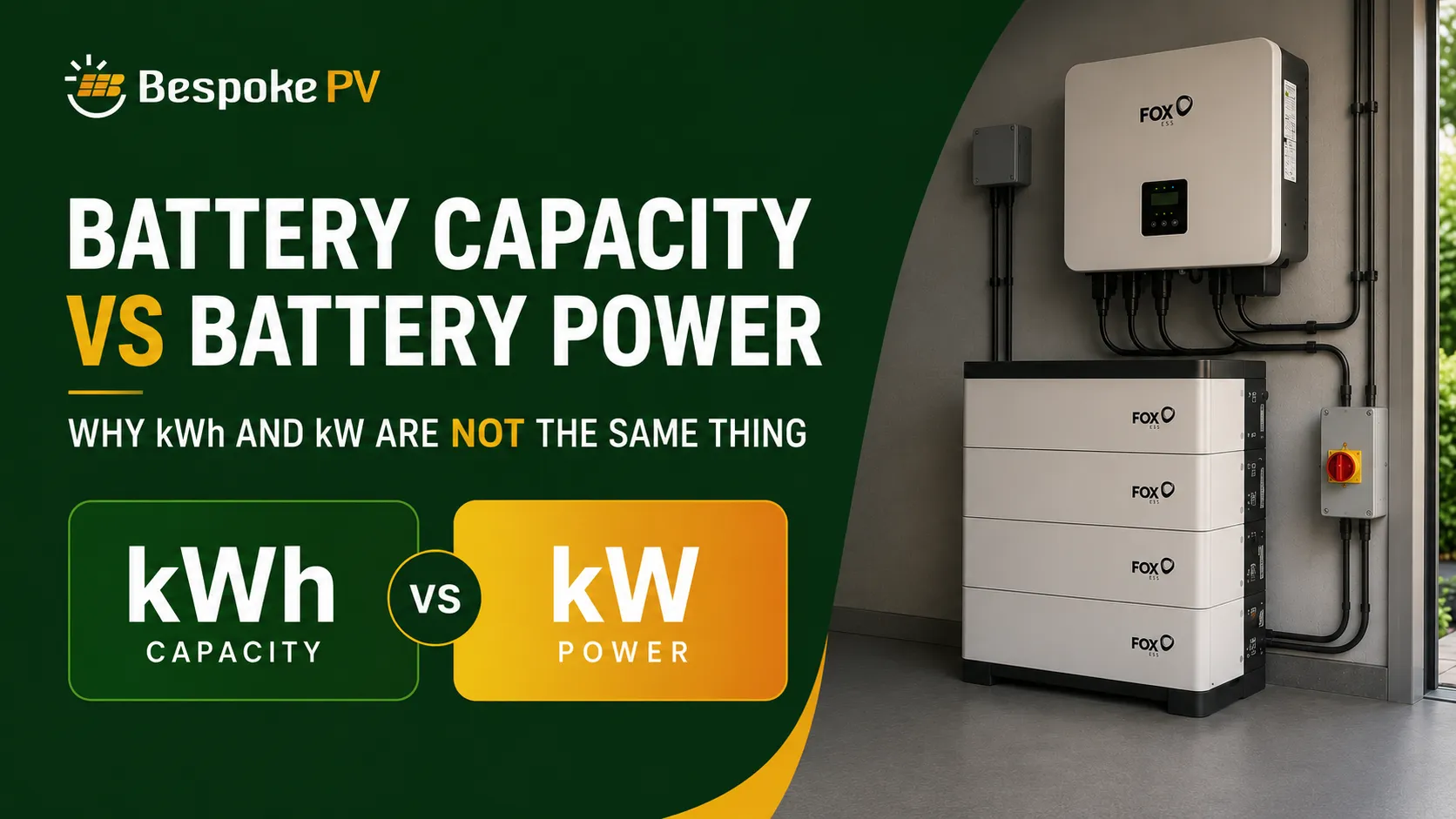
When considering backup power, it is important to distinguish between battery capacity and battery power.
Battery capacity, measured in kWh, determines how much energy is stored.
Battery and inverter power, measured in kW, determines how much demand can be supplied at one time.
A battery may contain plenty of stored energy, but if the inverter cannot deliver enough power for the appliances being used, the system may still be limited.
This is why backup design must consider both how long the battery should last and what it needs to power at any given moment.
Both affect backup performance in different ways.
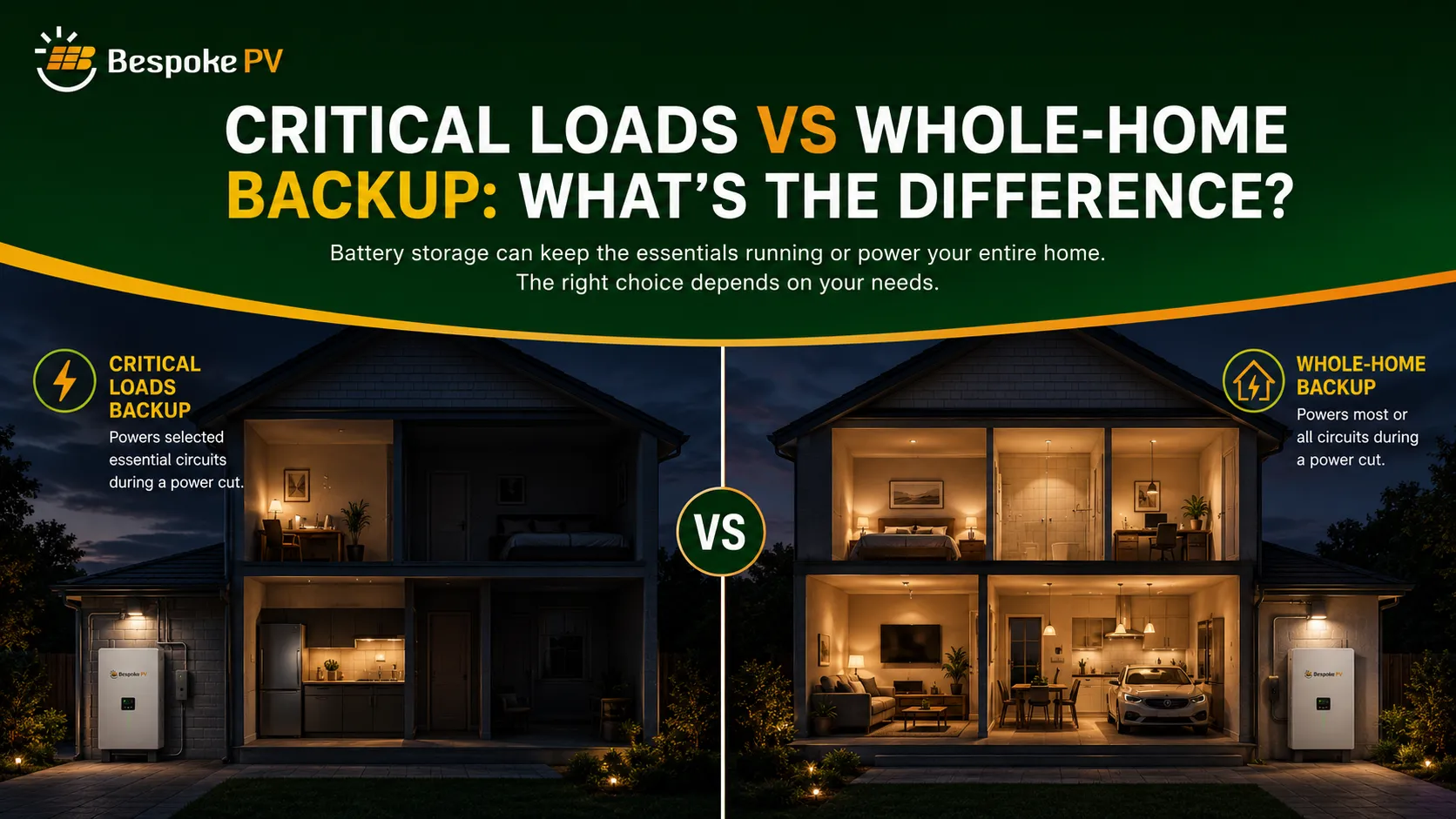
Critical loads backup is designed to support selected essential circuits during a power cut.
Rather than attempting to power the entire property, the battery supplies only the most important loads.
These might include lighting, refrigeration, internet equipment, heating controls, security systems, medical equipment or selected socket circuits.
Because fewer loads are supported, critical loads backup can often provide longer runtime from the same battery capacity.
For many homes, this is the most practical and cost-effective form of backup power.
These are typical examples of loads homeowners may want to keep running during an outage.
Whole-home backup is designed to support most or all of the property's electrical circuits during a grid outage.
This can provide a more convenient experience because the homeowner does not need to think as carefully about which circuits are protected.
However, whole-home backup is much more demanding than critical loads backup.
Modern homes can include electric ovens, hobs, kettles, showers, tumble dryers, washing machines, dishwashers, EV chargers and heat pumps.
If several of these are used at the same time, household demand can rise very quickly.
The right approach depends on what the homeowner expects the system to do.
Lower-power essential loads are usually easier to support from battery backup.
Lighting, refrigeration, broadband equipment, heating controls and small electronics may only require modest power compared with larger appliances.
A well-designed critical loads system can often keep these essentials running for a useful period, depending on battery capacity and reserve level.
This type of design is often suitable where the goal is resilience rather than continuing completely normal household operation.
High-power appliances need much more careful consideration.
Electric ovens, electric hobs, kettles, electric showers, tumble dryers, immersion heaters, heat pumps and EV chargers can all place significant demand on a backup system.
Some of these appliances may be possible to support with the right inverter and battery design.
Others may need to be excluded, limited or used carefully during an outage.
The key issue is not whether the battery contains enough energy overall, but whether the system can deliver enough power at that moment.
These appliances can quickly increase demand during a power cut.
One of the main limitations of smaller backup systems is inverter output.
A smaller inverter may support essential loads well, but it may require the homeowner to be careful about using several appliances at once.
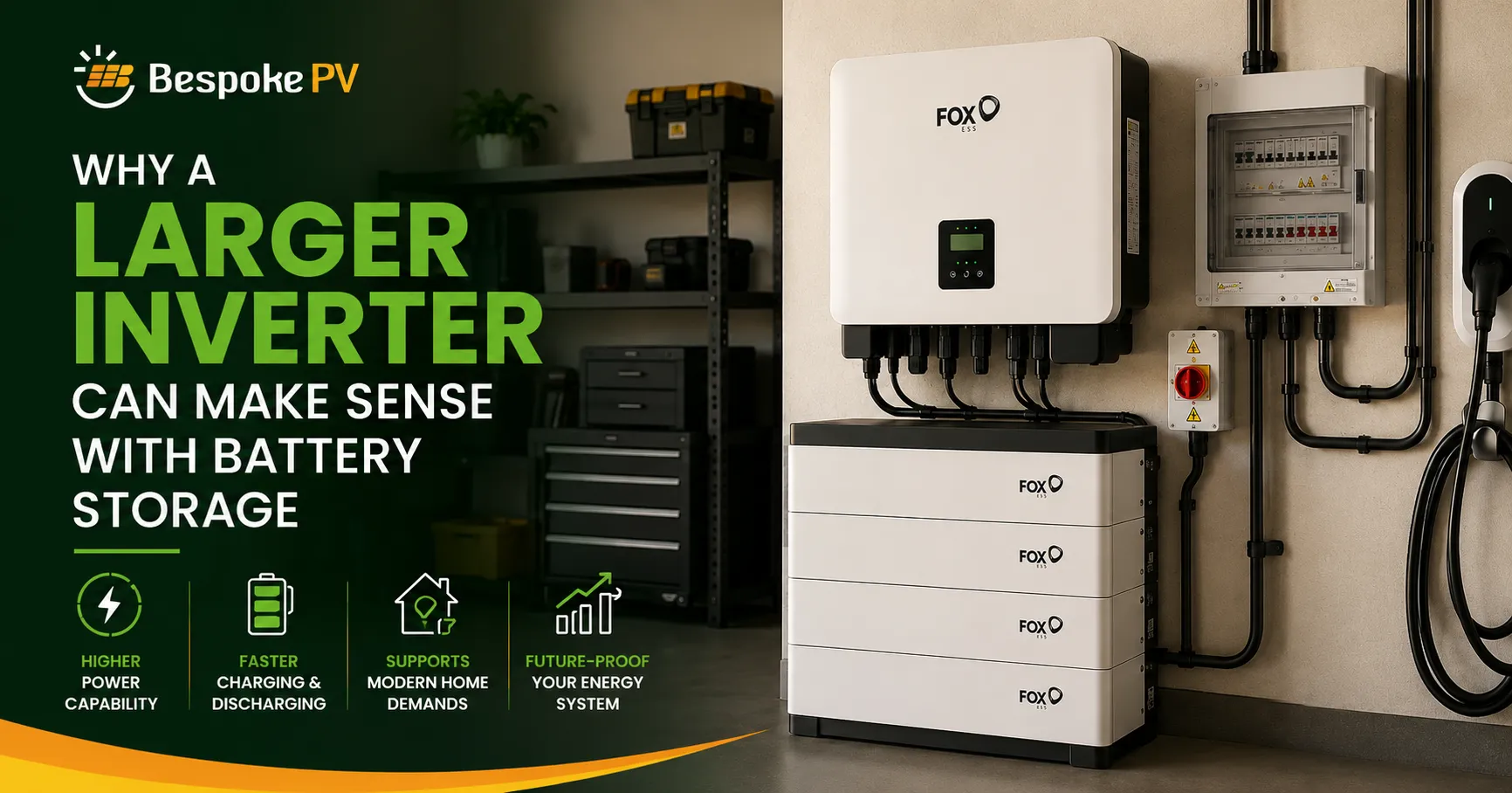
Where a sufficiently large battery is installed, specifying a larger inverter can reduce some of these limitations.
A larger inverter can allow more stored energy to be delivered to the property at one time, reducing the likelihood of overload and making the backup experience feel closer to normal household operation.
However, the battery must also be capable of supporting the higher discharge rate. A larger inverter alone is not enough if the battery cannot deliver the required power.
Inverter size can change how backup power feels in daily use.
Whole-home backup becomes much more realistic when battery capacity, battery discharge capability and inverter size are designed together.
The aim is not simply to install the biggest battery possible.
The aim is to create a system that can store enough energy, deliver enough power and behave predictably when the grid fails.
Backup duration depends entirely on what the battery is powering.
The same battery may support essential circuits for a much longer period than it could support an entire electrified home.
For example, lighting, refrigeration and broadband equipment may use relatively modest amounts of energy.
Cooking appliances, heating systems, laundry appliances, electric showers and EV chargers can drain stored energy much more quickly.
This is why runtime estimates should always be based on the actual loads being backed up rather than battery capacity alone.
Backup duration depends heavily on the loads being supported.
A home battery may comfortably support essential loads such as lighting, refrigeration, broadband equipment and heating controls for a useful period.
However, the same battery may be drained much faster if the household continues using high-power appliances as normal.
For example, boiling a kettle, cooking with an electric hob, running a tumble dryer or charging an electric vehicle can use far more power than lights, a fridge and a router combined.
This is why two homes with the same battery capacity can experience very different backup performance.
The difference is not just the size of the battery. It is what the battery is being asked to power.
If backup power is important, the battery needs energy available when the power cut happens.
A battery used purely for tariff optimisation may be discharged heavily each day to reduce electricity bills.
If a power cut occurs when the battery is nearly empty, there may be little energy available for backup operation.
Many battery systems allow a minimum reserve state of charge to be maintained.
This reserve can be held back for emergencies, but it also reduces the amount of battery capacity available for everyday tariff savings.
Battery settings should reflect the homeowner's priorities.
Solar panels can potentially help during a power cut, but this should not be assumed.
Many standard solar PV systems shut down during grid outages for safety reasons.
For solar generation to support the home during a power cut, the system must be designed with suitable backup capability.
Where solar and battery backup are configured correctly, solar generation may help power loads and recharge the battery during daylight hours.
However, performance will still depend on weather, time of day, battery state of charge and system design.
A battery-only backup system is limited to the energy already stored in the battery when the outage occurs.
A solar and battery backup system may be able to add energy during daylight hours, but only if the system is designed to allow solar operation during a grid outage.
This can make solar and battery backup more resilient, particularly during longer outages.
However, solar generation should still be treated as variable rather than guaranteed.
The battery reserve strategy remains important even where solar is present.
EV charging needs special consideration during backup operation.
Electric vehicle chargers can place a large demand on a battery system and may quickly deplete stored energy.
In many backup designs, EV charging is excluded, limited or controlled during an outage.
This helps preserve energy for household essentials.
If EV charging during a power cut is a key requirement, it should be discussed at the design stage because it may require significantly greater battery capacity, inverter output and load management.
Heat pumps also need careful assessment.
Some homeowners may want heating to continue during a power cut, especially where a heat pump is the primary heating system.
However, heat pump electricity demand varies depending on outdoor temperature, property heat loss, system design and operating conditions.
If heat pump backup is required, the system should be designed around realistic power demand and expected runtime.
It may also be sensible to consider which other loads will be used at the same time.
Whole-home backup can provide a more convenient experience, but it does not always mean every appliance should be used normally at the same time.
During a power cut, homeowners may still need to avoid running multiple high-power appliances together.
For example, using an electric shower, oven, hob, tumble dryer and EV charger at the same time could exceed the inverter output or drain the battery very quickly.
A well-designed system can provide resilience, but sensible load management can make stored energy last much longer.
Backup systems can manage demand in different ways.
Some designs rely on the homeowner using appliances carefully during a power cut.
Others may use dedicated circuits, contactors, changeover arrangements or smart controls to prevent certain high-demand loads from operating during backup mode.
This can protect the battery system from overload and help stored energy last longer.
For example, an EV charger, immersion heater or electric shower may be excluded from backup operation unless the system has been specifically designed to support it.
Good load management can make backup power more reliable and reduce the risk of nuisance shutdowns during an outage.
Backup systems can operate differently depending on the equipment and design.
Some systems provide an emergency power supply output for selected circuits.
Others may use additional changeover equipment to support wider parts of the property.
There may also be a short interruption before backup power becomes available.
The exact behaviour depends on the inverter, battery system, wiring design and backup configuration.
Homeowners should understand what will happen during a power cut before choosing a backup design.
Some battery inverters include an emergency power supply output, often designed to support selected backup circuits.
This should not be confused with a fully integrated whole-home backup system.
An emergency output may have its own power limit, wiring requirements and operating behaviour.
It may be suitable for essential circuits, but not necessarily for running the entire home as normal.
Whole-home backup usually requires more careful electrical design, suitable changeover equipment, appropriate inverter capacity and a clear understanding of which loads may operate during an outage.
This is why backup terminology should be checked carefully before choosing a system.
Backup expectations should be clear before the system is designed.
The most important part of backup design is understanding what the homeowner expects to happen during a power cut.
Some customers simply want the lights, fridge, router and heating controls to remain available.
Others want to cook, heat the home, use laundry appliances or continue operating almost normally.
Those are very different design requirements.
A system that is excellent for essential backup may disappoint a customer expecting whole-home operation.
Equally, a whole-home backup system may be unnecessary for a customer who only wants basic resilience.
Clear expectations at the design stage lead to better system choices and fewer surprises later.
There is no single backup design that suits every home.
Some homeowners want a cost-effective system that keeps essential services running during occasional outages.
Others want a more comprehensive whole-home backup solution that can support larger parts of the property.
Some prioritise tariff savings, while others value resilience more highly.
The right design depends on the property's loads, battery capacity, inverter power, reserve settings, future electrification plans and the homeowner's expectations.
A battery storage system can provide valuable backup power, but only when it is designed for that purpose.
The key questions are what needs to stay powered, how much power those loads require, how long they need to run and how much energy should be kept in reserve.
Answering those questions before installation helps avoid disappointment later.
It also ensures the system is designed around real-world resilience rather than assumptions about what a home battery can do.
Explore more Bespoke PV articles covering battery backup, inverter sizing, capacity, power output and whole-home resilience.
It can if the battery system has been designed and installed with backup functionality. A standard battery installation does not automatically provide power cut backup.
No. Many solar battery systems are designed for bill savings and solar storage, not backup power. Backup capability must be specified as part of the system design.
The main factors are battery capacity, inverter output, battery discharge capability, backup wiring design and how much reserve energy is kept available.
Battery capacity is how much energy is stored, measured in kWh. Battery power is how much energy can be delivered at one time, measured in kW.
Yes. A battery may contain stored energy, but if the appliance demand exceeds the inverter or battery output, the system may not be able to power it.
Critical loads are selected essential circuits or appliances that are prioritised during a power cut, such as lights, fridge, freezer, router and heating controls.
Critical loads backup powers selected essential circuits during a power cut rather than attempting to run the entire home.
Whole-home backup is designed to support most or all of the property during a power cut, but it requires greater inverter capacity, battery capability and careful load management.
Not always. Critical loads backup is often more practical and cost-effective, while whole-home backup offers more convenience but requires a more capable system.
Lower-power essential loads such as lights, fridge, freezer, internet router, heating controls and small electronics are usually easier to support.
High-power appliances such as electric showers, ovens, hobs, kettles, tumble dryers, immersion heaters, heat pumps and EV chargers need more careful design.
An electric shower is a very high-power load and may not be suitable for battery backup unless the system has been specifically designed to support it.
It may be possible with the right inverter and battery design, but cooking appliances can place significant demand on a backup system.
A kettle can draw a high amount of power for a short time, so whether it can be used depends on the inverter output and other loads running at the same time.
Yes, fridge and freezer loads are commonly included in critical loads backup designs, provided the system has enough capacity and suitable wiring.
Yes, internet routers and broadband equipment are common critical loads, although the wider broadband network must also remain operational.
Yes, heating controls are often suitable for backup power, but the heating system itself must be assessed depending on how it operates.
Potentially, but heat pumps can have significant and variable electricity demand, so the battery and inverter must be designed around realistic heating requirements.
EV charging during a power cut is usually excluded or limited because it can drain the battery quickly and requires substantial inverter output.
Yes. A larger inverter can allow more stored energy to be delivered at once, reducing overload risk where the battery can support the higher discharge rate.
No. The battery must also have sufficient capacity and discharge capability, and the electrical design must be suitable for whole-home backup.
Backup duration depends on battery capacity, reserve level and the loads being powered. Essential loads may run much longer than high-demand appliances.
Runtime depends on what the battery is powering. Lights and a router use far less energy than cooking appliances, heating loads or EV charging.
Battery reserve capacity is energy deliberately kept available for backup power rather than used for everyday tariff savings or solar self-consumption.
If backup power is important, keeping a reserve is sensible because a battery that is empty when the outage starts cannot provide much backup.
It can. Energy held in reserve is not normally available for daily tariff optimisation, so resilience and savings need to be balanced.
Only if the solar and battery system has been designed to operate during grid outages. Many standard solar PV systems shut down for safety during power cuts.
They can if the system is designed for solar operation during outages, but performance depends on weather, daylight, battery state of charge and system design.
Battery-only backup relies on stored energy already in the battery, while solar battery backup may also use daytime solar generation if the system is designed for outage operation.
Emergency power supply output is a backup output on some inverters, often intended for selected circuits rather than full whole-home backup.
No. An emergency power supply output may support selected backup circuits, while whole-home backup usually requires more extensive electrical design and equipment.
There may be a short interruption depending on the inverter, backup configuration and changeover arrangement.
Yes. If household demand exceeds the inverter or battery output, the system may overload or shut down unless loads are managed.
Load management means controlling which appliances or circuits can operate during backup mode to avoid overload and preserve stored energy.
Yes. Some systems can use selected circuits, smart controls, contactors or changeover arrangements to limit high-demand loads during backup mode.
Often, yes. EV chargers, immersion heaters, electric showers and other high-power loads may be excluded unless the system is specifically designed to support them.
Not always. Whole-home backup can support more of the property, but sensible appliance use may still be needed to avoid overload and preserve battery energy.
Modern electric homes may include heat pumps, EV chargers, electric cooking and high-power appliances, all of which increase backup power requirements.
A battery can provide quiet, automatic backup for suitable loads, but it has finite stored energy and should be designed around realistic power and runtime requirements.
You should decide which circuits must stay powered, whether whole-home backup is needed, how long backup should last and how much reserve capacity should be kept.
Sometimes, but it depends on the inverter, battery, wiring, installation layout and whether the equipment supports backup operation.
Backup requirements affect inverter choice, wiring design, battery sizing, reserve settings and which loads can be supported during an outage.
The best design depends on the homeowner's expectations. Some homes only need essential loads backup, while others need a more capable whole-home backup system.
Explore related Bespoke PV articles and renewable energy insights.
Explore renewable energy systems designed and installed by Bespoke PV.
Bespoke PV designs solar PV, battery storage and EV charging systems across Hampshire, Dorset and the South Coast.
Bespoke solar PV, battery storage and EV charging systems for Southampton homes and businesses, designed around roof space, usage and future energy plans.
Solar panels in Southampton →Bespoke solar PV, battery storage and EV charging systems for homes and businesses across Winchester and Hampshire.
Solar panels in Winchester →Solar PV, battery storage and EV charging systems for homes and businesses across Portsmouth and the South Coast.
Solar panels in Portsmouth →Solar PV, battery storage and EV charging systems for homes and businesses across Bournemouth and the South Coast.
Solar panels in Bournemouth →Bespoke PV designs solar PV, battery storage and EV charging systems across Hampshire, Dorset, Wiltshire and the South Coast.
Speak with Bespoke PV about designing a battery storage system around backup power, tariff savings, resilience and future energy needs.