Overnight Rate
How cheaply the battery can be charged.

A very low overnight electricity rate can make battery storage look extremely attractive. However, the cheapest overnight rate is only one part of the calculation. For battery storage to work well, the whole tariff structure needs to be considered.
Many time-of-use tariffs promote a very low overnight electricity rate.
For homeowners with battery storage, this can be attractive because the battery can charge when electricity is cheap and discharge later when electricity is more expensive.
However, focusing only on the cheapest overnight rate can be misleading.
Some tariffs with very low overnight rates also have higher daytime or peak rates.
In some cases, those peak rates may be higher than the customer's existing fixed tariff rate.
This means the tariff should be judged across the whole day, not just by its lowest price.
How cheaply the battery can be charged.
How expensive electricity becomes if the battery runs out.
How much low-cost electricity can be stored.
How quickly the battery can charge and support household demand.
When assessing a time-of-use tariff, the real comparison is not simply the overnight rate.
The more useful comparison is the total expected cost compared with the tariff the customer is already on.
A customer may currently pay a relatively stable fixed rate throughout the day.
Moving to a smart tariff may provide access to cheaper overnight electricity, but it may also expose the customer to higher peak pricing.
The battery therefore needs to save enough during low-cost periods to outweigh any expensive imports that still occur later.
Peak rates are particularly important because no battery system is unlimited.
If the battery runs out during a high-rate period, the home will import electricity from the grid at the peak tariff rate.
If that rate is higher than the customer's previous fixed tariff, those imports can quickly reduce the benefit of the cheap overnight charging window.
This does not mean the tariff is unsuitable.
It means the battery size, charge rate, discharge rate and household usage pattern all need to be considered before deciding whether the tariff works.
The lowest headline rate does not always produce the lowest bill.
Battery capacity plays a major role in whether a time-of-use tariff is suitable.
A larger battery can store more low-cost electricity and may reduce the amount imported during expensive periods.
However, the battery does not always need to cover the entire day's electricity usage.
The aim is usually to reduce the most expensive imports enough to make the overall tariff beneficial.
In many cases, a well-sized battery can deliver strong savings even if some peak-rate imports still occur.
A common misconception is that a battery must prevent all imports during expensive periods.
That is not always the most cost-effective objective.
Avoiding the majority of high-rate imports may deliver most of the available saving.
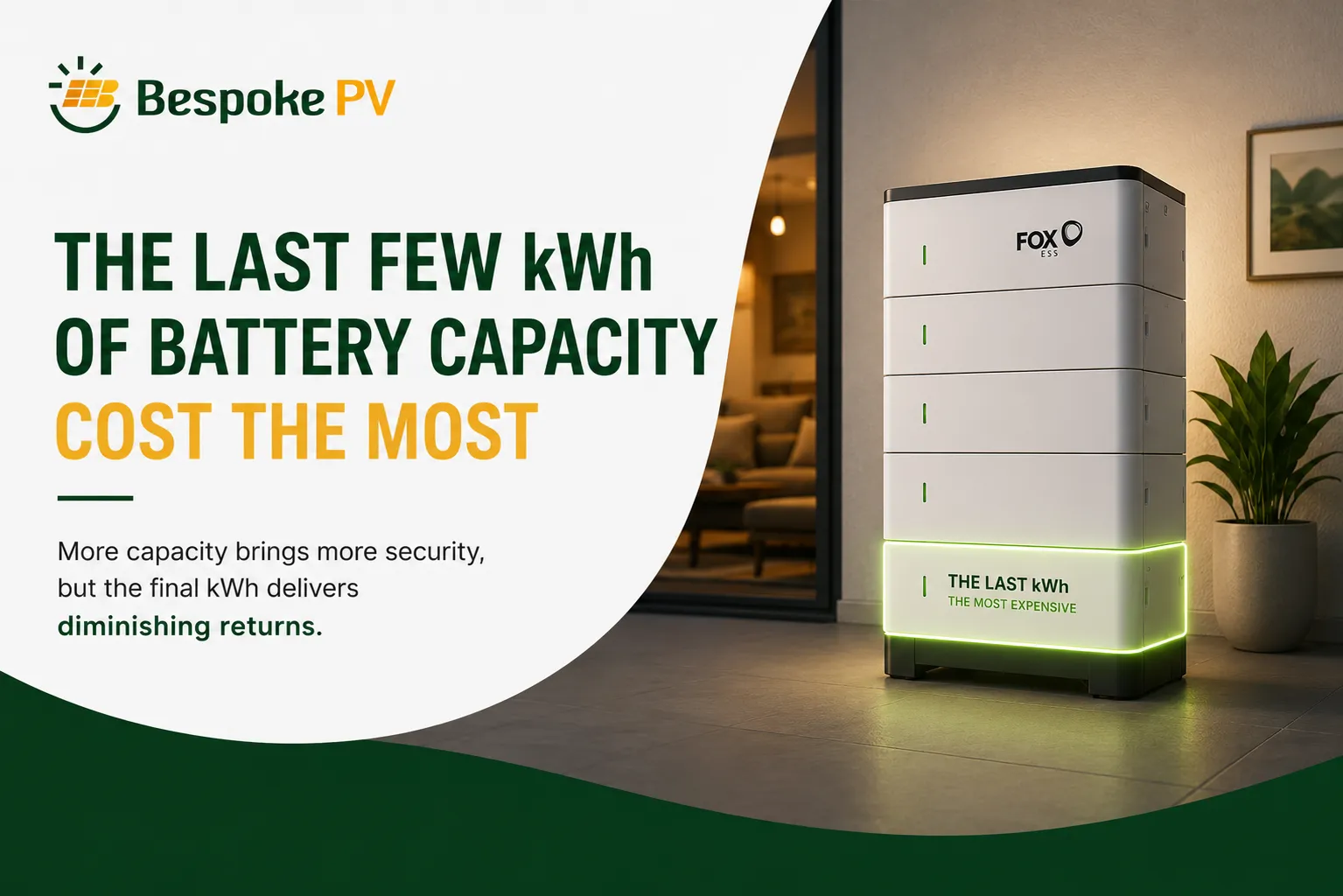
Trying to eliminate the final few kilowatt-hours of peak-rate import may require a much larger battery, increasing the installation cost significantly.
The right question is not always 'Can I avoid every peak import?'
It is 'Does the battery reduce enough expensive electricity to make the tariff worthwhile overall?'
The cheapest overnight rate is only useful if the battery system can make practical use of it.
A tariff that looks excellent on paper may perform poorly if the battery is too small, charges too slowly, discharges too slowly or runs empty during the most expensive periods of the day.
Not all time-of-use tariffs rely on a single overnight charging window.
Some tariffs may provide multiple lower-cost periods spread throughout the day.
This can significantly change the battery sizing calculation.
If the battery can be topped up more than once, it may not need to store enough energy to cover the entire period between one overnight charge and the next.
Instead, the system can operate in shorter cycles, charging during each lower-cost window and discharging during the more expensive periods in between.
This can reduce the amount of battery capacity required to achieve similar savings.
The number and timing of low-cost periods can affect battery size.
Battery capacity is one of the main cost drivers in a battery storage installation.
If a tariff provides several opportunities to recharge the battery, a smaller battery may be able to deliver much of the same financial benefit as a larger battery designed around a single overnight charge.
This can reduce upfront installation cost and may improve the payback period.
For example, instead of installing enough storage to carry the home from early morning through to late evening, the battery may only need to bridge the gaps between lower-cost periods.
The result can be a more cost-effective system if the tariff windows match the household's electricity usage pattern.
Multiple low-cost windows do not remove the need for good system design.
The battery still needs to charge quickly enough during each cheaper period to make useful use of the tariff.
If the charging window is short and the inverter or battery charge rate is limited, the system may not store enough low-cost electricity before the higher rate resumes.
This means battery capacity, charge rate and inverter size should still be assessed together.
A smaller battery may be suitable, but only if it can be recharged effectively during the available lower-cost periods.
Low-cost charging windows are often limited to specific times.
If the battery cannot charge quickly enough during that window, it may not store enough cheap electricity before the higher rate begins.
This is why inverter size, battery charge capability and system settings matter.
A battery with a large storage capacity may still underperform if the system cannot fill it quickly enough during the available off-peak period.
Even when electricity is cheap, the battery may not be able to charge as quickly as the homeowner expects.
Charging speed can be limited by several factors, including the inverter charge rate, the battery's maximum charge capability, the property's electrical supply, the main fuse rating and other loads running in the home at the same time.
This is particularly important for tariffs with short low-cost windows.
If a cheap period only lasts for a limited time, the system must be able to import and store enough energy before the price rises again.
A large battery connected to a smaller inverter may not be able to fill quickly enough to make full use of the available window.
Similarly, if the property is already using significant electricity at the same time, the spare import capacity available for battery charging may be reduced.
This means tariff suitability cannot be assessed by looking at battery capacity alone. Charge rate, inverter size and property supply limitations all influence how much low-cost energy can actually be stored.
Short low-cost windows can make battery charge rate more important than many homeowners realise.
For example, a large battery may look ideal on paper, but if the system can only charge at a modest rate, it may not store enough energy before the cheap period ends.
In this situation, the customer may still import electricity later at a higher rate, even though the battery itself has plenty of total storage capacity.
A battery system with a higher charge rate may be able to capture more low-cost energy during shorter tariff windows, improving the usefulness of the tariff.
This is one reason why inverter sizing and battery power capability should be considered alongside battery capacity when designing systems around smart tariffs.
Discharge power determines how much household demand the battery can support at one time.
If the property is using more power than the battery and inverter can supply, the home may still import electricity from the grid even while the battery contains stored energy.
This can be particularly important during evening periods when cooking, laundry, heating, hot water or EV charging may overlap.
A tariff strategy should therefore consider both battery capacity and battery power output.
Battery storage is not perfectly loss-free.
When electricity is charged into a battery and later discharged for use in the home, a small amount of energy is lost through the conversion and storage process.
This is often referred to as round-trip efficiency.
For tariff optimisation, this means the difference between the overnight rate and peak rate needs to be large enough to account for these losses.
A cheap overnight rate can still be very valuable, but realistic modelling should consider how much usable energy is actually returned from the battery.
Multiple lower-rate windows can improve battery economics in two ways.
First, they may reduce the size of battery required, lowering the upfront cost.
Second, they may increase how often the battery can be used productively throughout the day.
A battery that charges and discharges more strategically may provide better value than a larger battery that is only cycled once per day.
However, the benefit depends on the price difference between low-cost and high-cost periods, battery efficiency, household demand and how well the system is controlled.
This is why tariff modelling should consider the timing of each charging window, not just the cheapest rate available.
Multiple low-cost tariff windows can reduce the need for oversized battery storage.
Where a battery can be topped up during the day, the system may not need to carry the whole property from one overnight charge to the next.
This can reduce upfront cost and improve payback, but only when the battery, inverter and control strategy are designed around the actual tariff structure.
More frequent charging opportunities can improve tariff savings, but they can also increase battery cycling.
A battery used once per day on a simple overnight tariff may experience a different long-term duty cycle from a battery repeatedly charging and discharging in response to half-hourly price changes.
This does not mean agile tariffs or multiple charging windows are unsuitable. In some cases, frequent cycling can be financially attractive if the value of each cycle is high enough.
The important point is that cycling should be deliberate rather than uncontrolled.
A well-designed strategy should consider the saving created by each cycle, the battery's round-trip efficiency, the warranty terms, the expected useful life of the battery and the homeowner's overall payback objective.
Battery warranties often include limits based on time, cycle count, energy throughput or retained capacity.
Reaching a warranty cycle limit does not necessarily mean the battery has failed or become unusable.
In many cases, a battery may still retain a substantial proportion of its original usable capacity after many years of operation.
The warranty limit should therefore be understood as a manufacturer's warranty threshold, not as an automatic end-of-life point.
For homeowners, this distinction matters.
A battery that has reached a warranty milestone may still continue providing useful storage capacity, even if it no longer has the same guaranteed performance as when it was new.
The exact outcome depends on the battery chemistry, manufacturer warranty, operating conditions, depth of discharge, temperature, charge rates and how the system has been used.
It is easy to assume that cycling a battery more frequently is always undesirable.
However, the financial context matters.
If a battery is being used for tariff arbitrage and the savings are strong enough, a higher cycling strategy may still make sense.
For example, if a battery reaches a warranty cycle or throughput limit sooner because it has been used intensively, but it has also paid for itself during that period, the outcome may still be positive for the homeowner.
This is especially relevant for agile-style tariffs or tariffs with multiple low-cost charging windows, where the battery may be able to earn value more than once per day.
The key question is not simply how many cycles the battery uses.
The more useful question is whether those cycles are generating enough value to justify the additional usage.
Battery storage costs and technology may change over time, and future replacement options may be more attractive than those available today.
A homeowner who has achieved a rapid payback from tariff optimisation may be in a strong position even if the battery eventually needs replacement or expansion.
However, future battery prices should not be treated as guaranteed.
A sensible design should work financially using realistic assumptions today, while recognising that future storage products may offer improved capacity, performance or value.
This is another reason why payback period, useful life and future upgrade flexibility should be considered together rather than focusing only on warranty cycle limits.
A battery is designed to be used.
Avoiding cycles completely would preserve the battery, but it would also prevent the system from delivering savings.
The aim is not to minimise cycling at all costs.
The aim is to use the battery when doing so provides meaningful value.
For simple time-of-use tariffs, that may mean one main cycle per day.
For tariffs with multiple low-cost periods or half-hourly variable pricing, it may mean more frequent cycling when the price difference is large enough.
A good control strategy should avoid unnecessary low-value cycling while still allowing the battery to work hard when the financial benefit is clear.
Battery cycling should be viewed through the lens of value, not fear.
A battery that is cycled more frequently but pays for itself quickly may be a better investment than a battery that is preserved carefully but delivers limited savings.
At the same time, not every small price movement is worth acting on.
The best strategy balances tariff savings, battery health, warranty terms, payback period and long-term usefulness.
A low electricity price does not automatically mean the battery should charge.
The system should consider what the electricity will be used for later, what higher-rate period it is expected to avoid, and whether the price difference is large enough to justify the battery cycle.
For example, charging at a moderately low rate and discharging shortly afterwards to avoid only a slightly higher rate may produce very little net benefit once battery efficiency losses are considered.
By contrast, charging during a very low-cost or negative-price period and discharging during a high-price evening period may create a much stronger saving.
This is why intelligent control is important. The battery should not simply react to the cheapest half-hour in isolation. It should consider the wider tariff pattern, household demand, battery state of charge and expected future prices.
Some smart tariffs use half-hourly variable pricing rather than fixed low-cost and peak-rate windows.
These are often described as agile-style tariffs.
Instead of knowing that electricity will always be cheap during a set overnight period, the price can change throughout the day depending on wholesale market conditions and wider grid demand.
This can create opportunities for battery storage, but it also introduces more complexity.
A battery may be able to charge when prices are unusually low and avoid importing when prices rise sharply.
However, the system needs to be controlled intelligently to make this work reliably.
The main advantage of agile-style tariffs is flexibility.
Rather than relying on one fixed overnight charging window, homeowners may be able to take advantage of cheaper electricity whenever it appears.
In some periods, prices may fall very low or even become negative, creating opportunities to charge the battery at extremely low cost.
For homes with suitable battery storage, good charge rates and intelligent controls, this can increase the value of the system.
Agile tariffs can also reward households that are able to shift demand away from expensive periods and respond to changing grid conditions.
Different tariff structures create different battery control requirements.
Agile-style tariffs can also expose homeowners to higher pricing risk.
If the battery is empty during an expensive half-hour period, the home may import electricity at a much higher rate than expected.
If the system is not automated properly, or if the homeowner does not actively monitor pricing, the tariff may perform worse than a simpler fixed-rate or fixed time-of-use tariff.
Internet connectivity, software control, tariff integrations and system reliability all become more important.
A battery system that relies heavily on cloud control may also introduce additional risk if remote services are unavailable or pricing data is not acted on correctly.
Agile pricing can reduce the need for a very large battery in some circumstances because charging opportunities may occur more than once per day.
If the battery can be topped up during several low-price periods, it may not need to store enough energy to cover the full day from a single overnight charge.
This can reduce upfront battery capacity requirements and may improve payback.
However, the opposite can also be true.
If the homeowner wants to avoid exposure to high-price periods, the battery must have enough capacity and discharge power to bridge those expensive windows reliably.
This means agile tariffs do not remove the need for careful battery design. They make modelling even more important.
With a fixed tariff, battery charging can often be scheduled around predictable low-cost periods.
With an agile-style tariff, the best charging and discharging strategy may change daily.
This makes automation much more important.
The system may need to read pricing data, forecast household demand, consider battery state of charge and decide when to charge or hold energy back.
Without reliable automation, the homeowner may have to manage the tariff manually, which can quickly become inconvenient.
This is why local control, stable tariff integrations and dependable battery scheduling are important when using more dynamic tariffs.
Dynamic tariffs rely heavily on the battery system making the right decisions at the right time.
With a simple fixed overnight tariff, the battery may only need a predictable charging schedule.
With an agile-style tariff, the best charging and discharging strategy may change every day, and sometimes every half hour.
This makes automation much more important.
If internet connectivity is lost, tariff data is unavailable, cloud-based automation fails or a software integration stops working correctly, the battery may not charge or discharge in the most cost-effective way.
In some cases, this could mean missing low-cost charging opportunities. In others, it could mean importing electricity during expensive periods when the battery should have been available.
For this reason, fallback behaviour matters.
Homeowners should understand whether the battery can continue operating from a local schedule, whether settings can be adjusted manually, and how dependent the system is on cloud services or third-party integrations.
The more dynamic the tariff, the more important reliable control becomes.
Cloud-connected battery features can be useful, especially where tariff data, forecasting and automation are involved.
However, core operation should not become overly dependent on remote services.
If a battery system relies entirely on cloud-based control to respond to agile pricing, the homeowner is exposed to additional risks such as internet outages, server issues, software changes or long-term withdrawal of support.
Local control and sensible fallback settings can reduce these risks.
For example, if agile optimisation is unavailable, the system may still be able to follow a basic local schedule or maintain a minimum reserve level.
This may not produce the absolute maximum saving, but it can prevent the system from behaving unpredictably or failing to charge when needed.
For long-term energy infrastructure, resilience and control should be considered alongside headline tariff savings.
Agile tariffs can be powerful, but they are not automatically better.
They suit homeowners who have the right battery system, suitable controls and enough flexibility to respond to changing prices.
For many households, a simpler fixed time-of-use tariff may be easier to manage and more predictable.
The best tariff is not the one with the most exciting low-price periods. It is the one that works reliably with the battery system, household usage pattern and homeowner's appetite for price variability.
Where solar panels are installed, export payments can influence the best battery strategy.
However, homeowners should also check the terms of their import and export tariffs carefully.
Some customers may assume they can simply import electricity cheaply, store it in the battery and export it later at a higher rate.
In practice, supplier rules, tariff terms and export arrangements can vary.
Some tariffs may not be designed for straightforward import-export arbitrage, and some export rates may depend on eligibility criteria, metering arrangements or supplier-specific conditions.
This does not mean grid charging and export strategies are never useful, but they should be assessed carefully rather than assumed.
A responsible battery strategy should be based on the actual tariff terms, not just the apparent difference between import and export rates.
This is particularly important for customers combining battery storage, solar generation, smart import tariffs and export payments.
When solar panels are installed or may be added later, export rates can affect how the battery should be operated.
If export payments are low, storing surplus solar energy for later use may be more attractive than exporting it.
If export rates are strong, the best strategy may be less obvious.
In some cases, it may be financially sensible to export solar generation and charge the battery from low-cost grid electricity instead.
In other cases, using solar generation directly in the home or storing it in the battery may provide better value.
The best approach depends on import rates, export rates, battery efficiency, household demand, time of use and the customer's tariff terms.
This is why solar, battery storage and tariff selection should be considered together rather than treated as separate decisions.
The best tariff is not only a mathematical question.
It also depends on how the homeowner wants to live with the system.
Some customers are happy to use dynamic tariffs, monitor pricing, rely on automation and accept that savings may vary from day to day.
Others prefer a simpler and more predictable arrangement, even if the theoretical maximum saving is lower.
Agile-style tariffs may offer greater opportunities, but they can also involve more complexity, more price variability and greater reliance on automation.
Fixed time-of-use tariffs may be easier to understand because the charging windows are known in advance.
A standard fixed tariff may offer fewer optimisation opportunities, but it can provide predictability for customers who do not want to actively engage with changing energy prices.
The right tariff should therefore reflect the homeowner's appetite for complexity, risk and active energy management.
Different tariff types suit different households.
The best battery tariff strategy is not always the one that produces the largest theoretical saving on a spreadsheet.
It is the one that works reliably with the battery system, the property, the customer's usage pattern and the homeowner's appetite for risk and complexity.
For some customers, that may be an agile-style tariff with intelligent automation.
For others, a simpler fixed time-of-use tariff may provide a better balance of savings, predictability and convenience.
Good battery design should leave customers with options rather than locking them into a strategy that only works under one very specific tariff structure.
Not every household will be eligible for every smart tariff.
Some tariffs may require a compatible smart meter, half-hourly metering, an electric vehicle, a compatible EV charger, specific supplier arrangements or approved device integrations.
Battery compatibility can also affect how well a tariff can be used.
For example, the battery may need reliable scheduling, suitable charge and discharge rates, remote monitoring or integration with tariff data.
Before designing a battery system around a particular tariff, homeowners should confirm that they are eligible and that the battery system can operate in the required way.
A tariff that looks attractive online may not be suitable if the customer's meter, property, battery system or wider equipment does not meet the requirements.
Battery systems are long-term investments, but tariffs can change.
A tariff that looks attractive today may be withdrawn, altered or replaced in future.
This is why it can be risky to design a battery system around one tariff only.
A more resilient approach is to design around flexibility.
The system should be able to work with simple overnight charging, multiple low-cost windows, future solar generation, possible export tariffs and changing household demand.
This does not mean every system needs to be oversized.
It means the battery, inverter and control strategy should be chosen so the homeowner is not dependent on one narrow tariff opportunity remaining available forever.
A good battery tariff strategy depends on more than the overnight rate.
Imagine a customer currently pays a fixed electricity rate throughout the day.
They then consider switching to a time-of-use tariff with a much cheaper overnight rate but a higher peak rate.
If the battery covers most of the expensive evening period, the tariff may work very well.
However, if the battery runs out early or cannot discharge fast enough during high-demand periods, the home may import electricity at the higher peak rate.
The saving therefore depends on how much cheap electricity can be stored, how much expensive electricity can be avoided, and how much peak-rate import remains.
Two homes using the same amount of electricity per day may achieve very different results from the same tariff.
A household with high evening demand may need more battery capacity or discharge power than a household with flatter daytime usage.
A home with electric cooking, an electric shower, a tumble dryer, EV charging or a heat pump may experience larger demand spikes.
These usage patterns affect how much expensive electricity the battery can realistically avoid.
Some homeowners also want battery storage to provide backup power during a grid outage.
If backup power is a key requirement, part of the battery may need to be held in reserve.
That reserve energy cannot be used for normal tariff optimisation.
For example, if a customer maintains a reserve state of charge for emergency backup, the usable capacity available for avoiding peak-rate imports is reduced.
This does not make backup power a bad idea, but it does change the tariff calculation.
Battery settings should reflect the homeowner's priorities.
A tariff strategy that works well in summer may perform differently in winter.
Winter electricity demand is often higher, particularly in homes with heat pumps, electric cooking, tumble dryers or EV charging.
If solar panels are added later, solar generation will also vary significantly across the year.
This means tariff performance should be assessed over a realistic annual usage pattern rather than a single ideal day.
A good battery strategy should work across different seasons, not just during the easiest months.
Although this discussion is particularly important for battery-only installations, solar generation can improve the economics further if added later.
Solar panels can reduce daytime grid imports and may help recharge the battery before evening demand increases.
This means the battery is not relying only on overnight charging.
Solar generation can help bridge the gap between low-cost overnight electricity and expensive evening periods, reducing exposure to peak-rate imports.
For some homeowners, installing battery storage first and adding solar panels later can be a practical staged approach.
The battery can begin working with time-of-use tariffs immediately.
Later, solar panels can provide additional daytime energy and reduce reliance on grid charging.
However, this approach works best when the battery system is designed from the beginning with future solar integration in mind.
Inverter selection, equipment location and expansion capability should all be considered at the battery-only stage.
Although unit rates usually receive the most attention, other tariff details can also affect the overall outcome.
Standing charges, export rates, eligibility requirements, tariff windows and supplier conditions may all influence whether a tariff is suitable.
For solar customers, export terms may also become relevant.
This is another reason why the cheapest overnight import rate should not be assessed in isolation.
A proper tariff assessment should consider the whole energy picture.
The best tariff is not always the one with the lowest headline rate.
It is the tariff that works best with the customer's battery system, household usage and long-term plans.
A proper assessment should consider when electricity is used, how much the battery can store, how quickly it can charge, how quickly it can discharge and what happens when the battery runs out.
Without this analysis, headline tariff comparisons can be misleading.
Different households use electricity in very different ways.
A tariff that works well for one property may be less suitable for another.
Homes with high evening demand, electric heating, EV charging or limited battery capacity may respond differently to the same tariff.
This is why choosing a tariff should not be based purely on headline rates or what works for another household.
The tariff should be matched to the battery system, usage pattern and long-term energy plans.
A very low overnight tariff can be valuable, but only when the battery system is able to make effective use of it.
If peak rates are high, battery sizing and usage patterns become even more important.
For many homeowners, the best result comes from matching the battery system, tariff structure and future energy plans together.
That is why tariff advice and battery design should be considered as part of the same conversation.
Explore more Bespoke PV articles covering battery sizing, smart tariffs, backup power and future-ready energy design.


Not necessarily. The whole tariff structure should be considered, including peak rates, daytime rates, standing charges and how well the battery can use the cheap charging window.
A very low overnight rate may be paired with higher daytime or peak rates, which can reduce savings if the battery runs out during expensive periods.
Yes. Some time-of-use tariffs have peak rates that may be higher than a customer's existing fixed tariff rate.
A battery tariff should be compared against the customer's existing tariff and expected whole-day electricity cost, not just the cheapest overnight rate.
Peak rates matter because the home may still import electricity from the grid if the battery is empty or cannot meet household demand.
Not always. A battery may still be cost-effective if it avoids enough expensive imports to make the overall tariff beneficial.
Yes. A smaller battery can still be effective if it covers the most expensive periods of the day and is matched to the household's usage pattern.
Battery size affects how much low-cost electricity can be stored and how long the home can avoid importing at higher rates.
Charge rate matters because the battery may need to store enough electricity during a limited low-cost charging window.
Discharge rate affects how much household demand the battery can support during expensive periods.
Yes. If household demand exceeds the battery or inverter output, the home may still import electricity from the grid.
The home will import electricity from the grid at the applicable peak rate, which may be higher than a standard fixed tariff.
Yes. Evening demand, appliance use, EV charging, heat pumps and daily routines can all affect whether a tariff works well with battery storage.
Yes. Energy kept in reserve for backup power cannot be used for normal tariff optimisation, which may reduce savings.
Not always. If backup power is important, some energy may need to be kept in reserve for power cuts.
Yes. Tariff optimisation uses stored energy to reduce bills, while backup resilience may require keeping stored energy available for outages.
Yes. Solar panels can reduce daytime imports and help recharge the battery, reducing reliance on overnight grid charging.
Yes. Solar panels can often be added later to reduce grid imports and improve battery performance during daylight hours.
No. Tariffs can change, so battery systems should be designed with enough flexibility to remain useful across different tariff structures.
Yes. Standing charges can affect the total cost of a tariff and should be considered alongside unit rates.
Yes. Export rates may affect the overall value of a tariff if solar panels are installed or added later.
A good battery tariff should suit the household's usage pattern, battery size, charge rate, discharge rate, backup settings and future energy plans.
Yes. A low overnight rate can be very useful, but only when the battery system can store and use enough low-cost energy effectively.
Proper modelling helps estimate total electricity cost across the day rather than relying on headline overnight rates.
Homeowners should consider overnight rates, peak rates, existing tariff costs, battery capacity, charge speed, discharge power, backup reserve settings and future solar plans.
Yes. Some time-of-use tariffs may offer multiple lower-cost periods spread throughout the day rather than one overnight window only.
Yes. If the battery can be topped up more than once per day, it may not need to store enough energy to cover the entire day from one overnight charge.
They may improve payback by reducing the battery capacity required and allowing the battery to charge and discharge more strategically throughout the day.
Yes. The battery still needs to charge quickly enough during each lower-cost period to make effective use of the tariff.
Potentially, yes. If less battery capacity is needed to achieve similar savings, the upfront installation cost may be lower.
It can be. A single overnight charging window may require a larger battery because the system has to cover a longer period before the next cheap-rate opportunity.
The timing matters because lower-cost periods need to align with battery charging capability and household demand patterns to produce useful savings.
Yes. A smaller battery may work well if it can recharge during several cheaper periods and discharge during the more expensive periods between them.
Yes. Proper modelling should include every low-cost and high-cost period, as well as battery size, charge rate, discharge rate and household usage.
An agile-style tariff uses variable pricing that can change throughout the day, often in half-hourly periods.
Yes. Agile tariffs can work well when the battery system can charge during low-price periods and avoid imports during expensive periods.
They can be. Agile tariffs may expose homeowners to high prices if the battery is empty or the system does not respond correctly to changing rates.
Potentially. If low-price periods occur several times per day, the battery may be topped up more often and may not need to cover the full day from one charge.
Sometimes. If the goal is to avoid high-price periods reliably, the battery must have enough stored energy to bridge those expensive windows.
Automation matters because prices can change frequently, so the battery may need to adjust charging and discharging decisions throughout the day.
They can be, but manual management can be inconvenient because prices change regularly and the best charging periods may vary each day.
The main risks include high-price imports, poor automation, internet or software issues, insufficient battery capacity and inadequate charge or discharge power.
Yes. Agile tariffs often require a more dynamic charging strategy than fixed overnight tariffs because low-price periods may move from day to day.
No. Agile tariffs can offer strong opportunities, but fixed time-of-use tariffs may be simpler, more predictable and easier to manage for some households.
Frequent cycling can contribute to battery wear, but the financial value of each cycle should also be considered when using smart tariffs.
No. A warranty cycle limit is not the same as the battery failing. The battery may still retain useful storage capacity after reaching a warranty threshold.
Yes, if the tariff savings are strong enough, more frequent cycling may still be financially worthwhile even if the battery reaches warranty limits sooner.
Not necessarily. The saving should be large enough to justify battery efficiency losses, cycling and long-term wear.
Yes. Many batteries may still provide useful storage capacity after warranty thresholds are reached, although guaranteed performance depends on the manufacturer's terms.
If a battery pays for itself quickly through tariff savings, higher cycling may be acceptable as part of the overall investment strategy.
Yes. Battery storage technology and pricing may change over time, but system design should still be based on realistic assumptions today.
Explore related Bespoke PV articles and renewable energy insights.


Explore renewable energy systems designed and installed by Bespoke PV.

Bespoke PV designs solar PV, battery storage and EV charging systems across Hampshire, Dorset and the South Coast.
Bespoke solar PV, battery storage and EV charging systems for Southampton homes and businesses, designed around roof space, usage and future energy plans.
Solar panels in Southampton →Bespoke solar PV, battery storage and EV charging systems for homes and businesses across Winchester and Hampshire.
Solar panels in Winchester →Solar PV, battery storage and EV charging systems for homes and businesses across Portsmouth and the South Coast.
Solar panels in Portsmouth →Solar PV, battery storage and EV charging systems for homes and businesses across Bournemouth and the South Coast.
Solar panels in Bournemouth →Bespoke PV designs solar PV, battery storage and EV charging systems across Hampshire, Dorset, Wiltshire and the South Coast.
Speak with Bespoke PV about battery storage, time-of-use tariffs and designing a system around your real electricity usage.