First kWh of Storage
Usually offsets the most expensive electricity.

When comparing battery storage systems, it is easy to assume that more capacity always means better value. In reality, the first few kilowatt-hours of storage often deliver the biggest financial benefit, while the last few can be the most expensive to justify.
Battery storage is often compared by capacity.
A 20kWh battery sounds more capable than a 10kWh battery, and in many ways it is.
However, the question is not simply how much energy the battery can store.
The more important question is how often that extra storage will be used, what electricity cost it will avoid, and whether the additional savings justify the additional upfront cost.
In many homes, the most cost-effective battery is not the largest battery available. It is the battery that covers the highest-value use cases without paying for capacity that is rarely needed.
Usually offsets the most expensive electricity.
Helps cover normal daily demand and tariff optimisation.
May only be used on high-consumption days.
Balances savings, resilience, future needs and upfront cost.
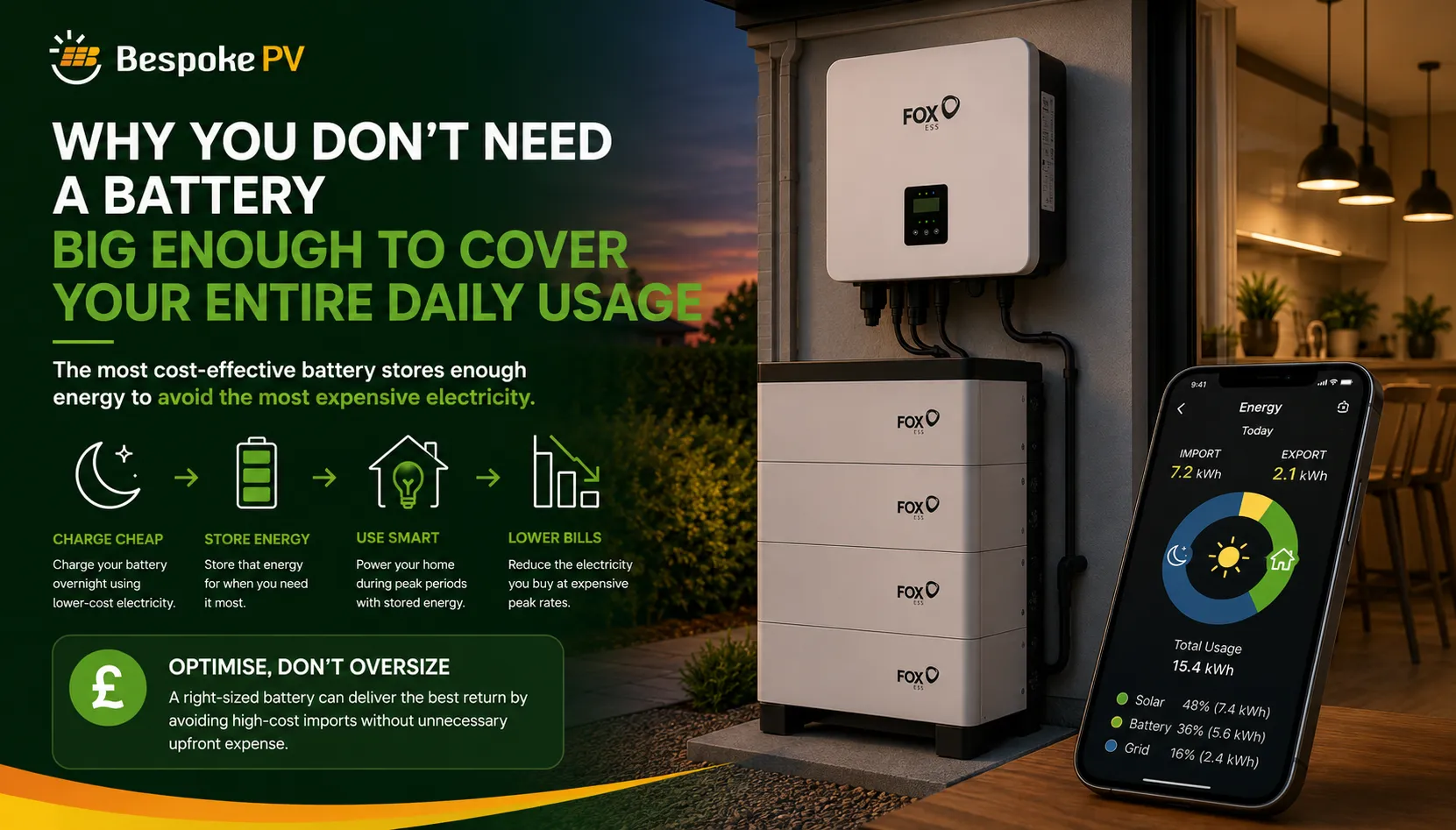
The first portion of battery capacity often delivers the greatest financial benefit.
This is because it is usually used every day to offset the most expensive electricity imports.
For example, a battery may charge during a low-cost tariff period and discharge during the evening when rates are higher.
If the battery is sized well, the early portion of storage may be used consistently and productively.
That regular use can create strong savings and a clearer payback case.
As battery capacity increases, the additional storage may not be used as consistently.
The final few kilowatt-hours of capacity might only be needed on unusually high-consumption days, during longer peak-rate periods, in poor weather, or when several high-demand appliances are used together.
That extra capacity can still be useful, but it may not generate savings every day.
This is where diminishing returns appear.
The customer pays for the additional capacity upfront, but the financial benefit may only appear occasionally.
Not all battery capacity contributes equally to savings.
Consider a household using 20kWh of electricity per day.
It may seem logical to install a 20kWh battery.
However, if much of the most expensive electricity occurs during a smaller evening window, a 10kWh or 12kWh battery may already avoid a large proportion of the high-rate imports.
Increasing the battery to 20kWh may reduce imports further, but the extra saving may be smaller than expected.
The larger battery costs more, but the additional capacity may only be used fully on certain days.
That does not make the larger battery wrong, but it changes the financial calculation.
Battery capacity is one of the main cost drivers in a battery installation.
Adding more capacity increases upfront cost, even if the additional capacity is only used occasionally.
This can extend the payback period.
A smaller, well-used battery may sometimes produce a better return than a larger battery that spends much of its time partially unused.
This is why battery design should focus on value, not just size.
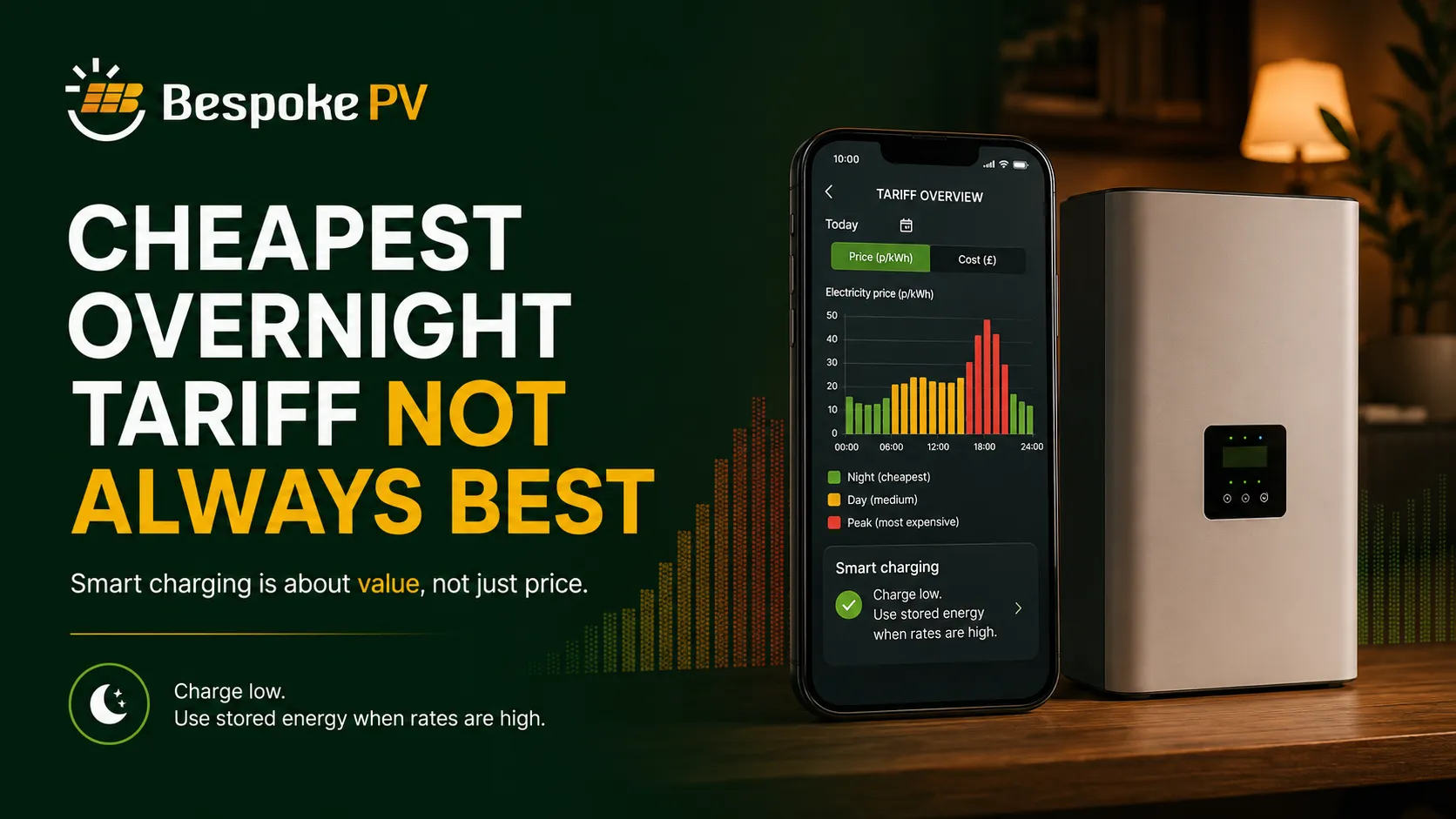
Time-of-use tariffs can make battery storage very attractive, but the tariff structure matters.
If there is one low-cost overnight charging window, the battery may need to bridge a long period before the next cheap-rate opportunity.
In that situation, a larger battery may be more useful.
However, if the tariff provides multiple lower-cost charging windows throughout the day, the battery may be topped up more than once.
This can reduce the amount of capacity required because the battery does not need to carry the property from one overnight charge to the next.
Tariff structure can affect how much storage is required.
Agile-style tariffs with half-hourly variable pricing can create more opportunities for battery storage.
The battery may be able to charge when prices fall and discharge when prices rise.
This can improve savings, but it also makes sizing more complex.
A smaller battery may work well if there are frequent low-price periods to recharge from.
However, if the homeowner wants to avoid exposure to high-price periods reliably, additional capacity may still be valuable.
The best size depends on the price pattern, battery charge rate, discharge rate, automation strategy and household demand.
The best battery size is rarely found by simply matching daily electricity usage.
It is found by understanding which electricity costs the most, when the home uses power, how often the battery can recharge, and whether the additional capacity will be used often enough to justify its cost.
Capacity is only one part of battery design.
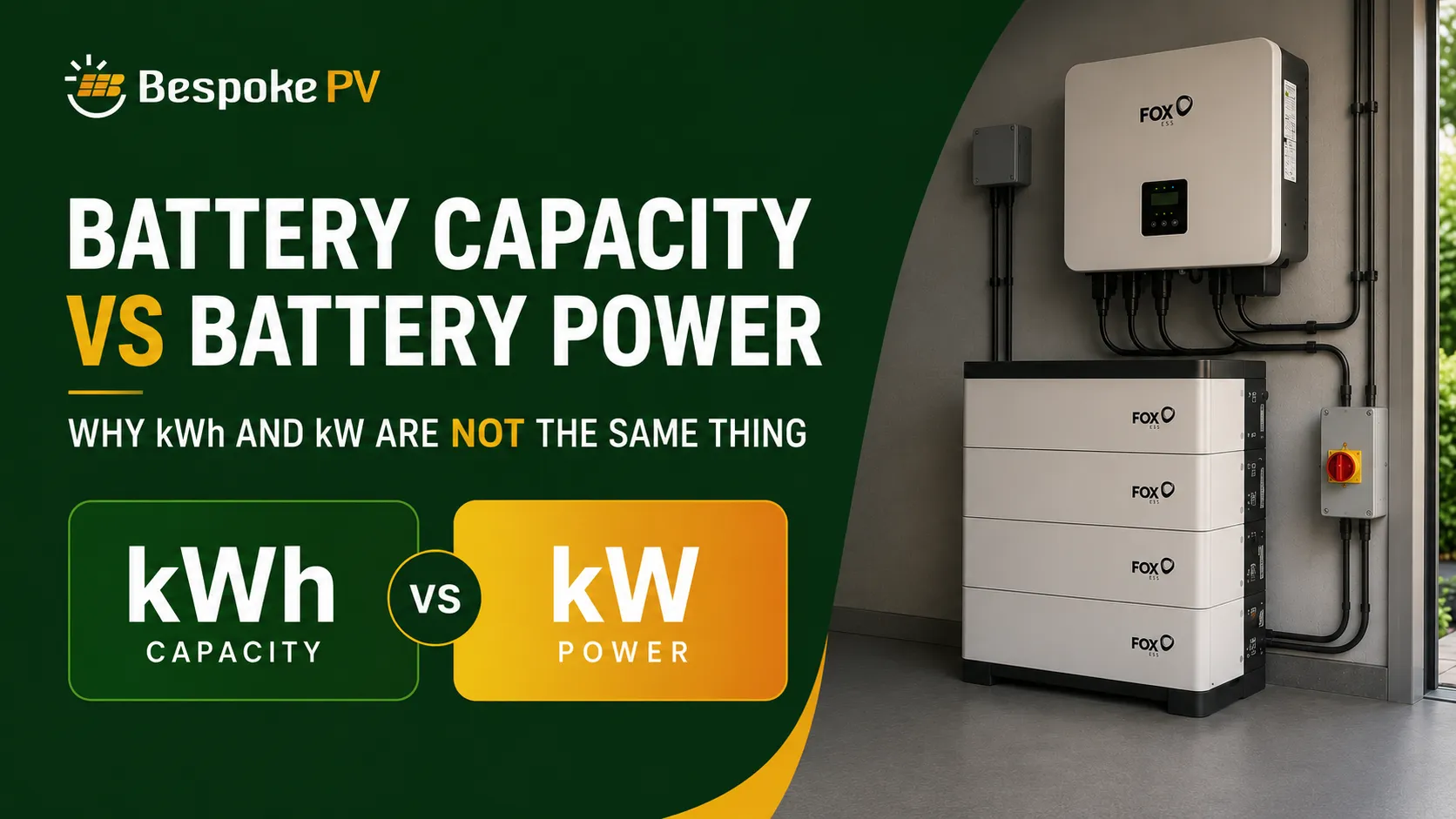
A larger battery does not automatically mean the home can use more stored energy at once.
Battery discharge power and inverter size determine how much power can be delivered at any given moment.
If the home is using more power than the inverter can supply, the property may still import from the grid even while the battery contains stored energy.
This is why kWh and kW should always be considered together.
There are many situations where additional battery capacity can be justified.
A larger battery may make sense where the home has high electricity demand, longer peak-rate periods, limited charging opportunities, backup power requirements or future electrification plans.
The key is understanding why the extra capacity is being added.
If it is added to improve resilience, support future EV charging, help with heat pump demand or maintain backup reserve, the value may not be purely financial.
In those cases, payback is only part of the decision.
Additional capacity can be valuable when it serves a clear purpose.
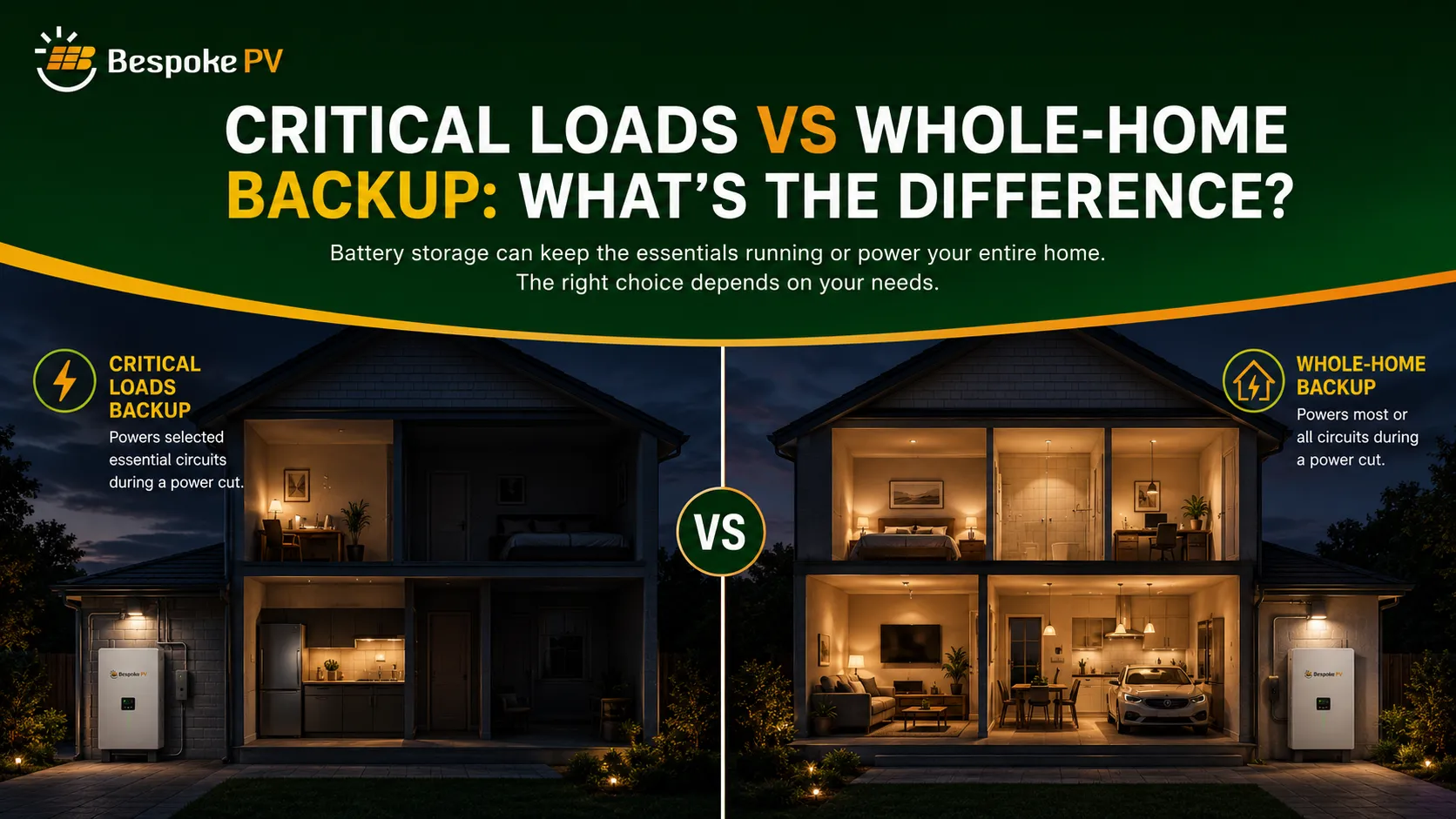
If the battery is also expected to provide emergency backup power, some capacity may need to be kept in reserve.
That reserved energy is not available for normal tariff optimisation.
For example, a homeowner may choose to keep 20%, 30% or more of the battery available for power cuts.
In that case, a larger battery may be justified because only part of the total capacity is being used for daily savings.
This means backup requirements can make a battery appear oversized from a payback perspective, while still being entirely sensible from a resilience perspective.
A battery system may remain in service for many years.
During that time, household electricity demand may increase.
Electric vehicles, heat pumps, electric cooking, electric hot water and wider home electrification can all change how much energy the property uses.
A battery that looks generous today may become more appropriate as the home becomes more electrified.
For some homeowners, adding extra capacity is therefore a future-proofing decision rather than a simple payback decision.
For battery-only installations, the battery may initially rely on grid charging during low-cost tariff periods.
If solar panels are added later, daytime generation can reduce the burden on the battery.
Solar can supply household loads directly and may also help recharge the battery before evening demand increases.
This means a battery that might seem slightly small in a battery-only scenario may perform very well once solar generation is introduced.
For staged installations, future solar plans should therefore be considered before oversizing the battery purely to cover every daytime import.
Solar generation can reduce how much storage is needed.
When solar panels are installed, battery sizing should not only consider import savings.
Export tariffs can also affect how much battery capacity is useful.
If surplus solar generation is exported at a flat rate, the homeowner receives the same export payment regardless of when the energy is sent to the grid.
If the export tariff varies by time of day, the timing of export can become much more important.
This means the battery may be used not only to avoid expensive imports, but also to shift solar energy towards higher-value export periods.
As a result, agile or time-of-use export tariffs can sometimes make additional battery capacity more valuable than it would appear from import savings alone.
Export tariff structure can influence how much battery capacity is useful.
With a flat rate export tariff, every exported kilowatt-hour receives the same value regardless of when it is exported.
If the export rate is reasonably attractive, there may be less need to store every surplus kilowatt-hour of solar generation.
In that situation, oversizing the battery purely to avoid export may not always make financial sense.
The homeowner can still receive value from surplus solar by exporting it directly.
This does not mean battery storage is unnecessary, but it changes the calculation.
The battery should be sized around the value of avoiding imports, improving self-consumption, supporting tariff strategy, providing backup reserve and preparing for future demand, rather than simply trying to capture every unit of solar generation.
Time-of-use and agile-style export tariffs can create a different opportunity.
If export rates are higher during certain periods, a battery may be used to store surplus solar generation and export it later when the export value is greater.
This can make additional battery capacity more useful because the battery is no longer only avoiding imported electricity. It may also be increasing the value of exported solar energy.
For example, surplus midday solar may be stored and then exported during an evening period when grid demand is higher and export rates are more attractive.
In this type of arrangement, the last few kilowatt-hours of capacity may have a clearer role than they would under a simple flat export tariff.
However, this depends on the size of the export price difference, battery efficiency, inverter capability, export limits and the household's own demand.
Battery strategy becomes more complex when both import and export tariffs vary.
Sometimes the best use of stored energy is to supply the home and avoid importing at a high rate.
At other times, it may be better to export energy if the export value is particularly strong.
The battery control strategy should therefore compare the value of using stored energy in the home against the value of exporting it.
For example, if the home would otherwise import electricity at a high peak rate, self-consumption may be the better use of the battery.
If the export rate is unusually high and household demand is low, exporting stored solar energy may be more attractive.
This is why solar, battery storage, import tariffs and export tariffs should be modelled together rather than separately.
Storing solar energy for later export is not loss-free.
When solar energy is stored in a battery and later discharged, some energy is lost through the charging and discharging process.
This means the difference between the immediate export value and the later export value needs to be large enough to justify storing the energy first.
If the export rate only increases slightly, it may be better to export solar generation directly rather than cycle the battery for a small gain.
If the later export rate is significantly higher, storing energy for export may become more worthwhile.
As with import tariff arbitrage, the value of each battery cycle should be considered carefully.
The value of time-shifting solar export also depends on how much power the system can actually export.
Export may be limited by DNO permissions, inverter capacity, system settings or tariff terms.
If export power is restricted, a larger battery may not be able to release all stored energy during a short high-value export window.
Similarly, if the inverter is already supporting household loads, battery discharge or backup reserve requirements, there may be limits on how much energy can be exported at the ideal time.
This is another reason why battery capacity, inverter size and export strategy should be designed together.
Adding more kWh of storage only helps if the system can actually use or export that energy when it has the greatest value.
Solar export tariffs can turn battery sizing into a two-sided calculation.
The battery may create value by avoiding expensive imports, but it may also create value by improving when solar energy is exported.
Under a flat export tariff, extra capacity may be harder to justify if surplus solar already receives a fair export payment.
Under a time-of-use or agile export tariff, extra capacity may become more attractive if it allows solar energy to be shifted into higher-value export periods.
The best design depends on the relationship between import rates, export rates, battery efficiency, inverter power, export limits and household demand.
A larger battery may be easier to justify where it has multiple jobs.
For example, the battery might store cheap overnight electricity, absorb surplus solar generation, avoid expensive peak imports, maintain backup reserve and export energy during higher-value periods.
When a battery is serving several purposes, additional capacity may be used more often and may create value in more than one way.
This can reduce the risk that the final few kilowatt-hours sit unused.
However, the opposite can also be true.
If export rates are flat and attractive, household demand is modest and backup reserve is not required, a very large battery may still produce diminishing returns.
This is why battery sizing should be based on the complete tariff and usage picture rather than solar generation alone.
The last few kilowatt-hours of battery capacity can be the most difficult to justify financially.
They cost money upfront, but they may only save money on certain days.
If those extra kilowatt-hours are rarely cycled, the annual saving they create may be relatively small.
This can extend the payback period compared with a smaller battery that is used more consistently.
That does not mean extra capacity is bad. It means the reason for adding it should be clear.
Battery sizing should always start with the customer's objective.
If the goal is fastest financial return, a smaller optimised battery may be best.
If the goal is resilience, backup reserve or whole-home backup, additional capacity may be justified.
If the goal is future electrification, extra storage may make sense even if today's usage does not fully require it.
A good battery design should balance upfront cost, tariff savings, backup requirements, future flexibility and real-world usage.
The best battery system is not always the largest one.
A carefully sized battery can often capture most of the available savings while avoiding the additional cost of capacity that is rarely used.
For some homes, a larger battery will be the right answer.
For others, the best result comes from a more balanced system with appropriate inverter power, suitable charge rates, smart controls and future expansion options.
The goal should be to design a battery system that works hard, pays back sensibly and remains useful as the home changes over time.
Battery sizing can appear complicated because tariffs, usage patterns, solar generation, export rates, backup requirements and future electrification all interact.
However, homeowners do not need to calculate all of this themselves.
The purpose of good system design is to translate these variables into a practical recommendation.
A well-designed battery system should be large enough to deliver meaningful savings and resilience, but not so large that the final units of storage add unnecessary cost without clear benefit.
That is why battery sizing should be based on modelling, objectives and future plans rather than simple rules of thumb.
Explore more Bespoke PV articles covering battery sizing, tariff optimisation, inverter selection and future-ready energy design.
Not necessarily. A larger battery can store more energy, but additional capacity may deliver diminishing returns if it is rarely used.
The final few kilowatt-hours may cost more upfront but only be used occasionally, which can reduce their financial return.
Diminishing returns means each additional unit of battery capacity may provide less extra saving than the capacity added before it.
The first portion of battery capacity is often used most frequently to offset the most expensive electricity imports.
Yes. Extra capacity can be useful for high-demand days, backup reserve, future electrification or longer peak-rate periods.
Not always. Battery sizing should consider tariff structure, usage pattern, charge opportunities, backup needs and future energy plans.
Yes. A smaller battery may deliver most of the available savings if it covers the most expensive periods of electricity use.
A very large battery may cost significantly more upfront, while the extra capacity may only create savings on certain days.
Time-of-use tariffs affect battery size because the battery must store enough low-cost energy to reduce imports during more expensive periods.
Potentially, yes. If the battery can recharge during several lower-cost periods, it may not need to store enough energy for the entire day.
Yes. Agile tariffs can create multiple charging opportunities, but they may also require enough capacity to avoid high-price periods.
Yes. Capacity determines how much energy can be stored, while power determines how quickly that energy can be delivered to the home.
Yes. If household demand exceeds the inverter or battery discharge capability, the home may still import from the grid even when stored energy remains.
A larger battery may be worth it for high electricity demand, backup reserve, whole-home backup, future EV charging, heat pumps or longer peak-rate periods.
It can. If reserve energy is needed for power cuts, additional capacity may be justified even if it does not maximise financial payback.
Battery reserve capacity is stored energy intentionally kept available for backup power rather than used for normal tariff savings.
Yes. EV charging can increase household electricity demand and may justify additional storage or future expansion planning.
Potentially, yes. Heat pumps can increase electricity consumption and may influence battery capacity, inverter size and tariff strategy.
Yes. Solar generation can supply daytime loads and help recharge the battery, reducing reliance on stored overnight electricity.
Yes. Future solar generation can change how much battery capacity is needed and how the system should be designed.
Not always. Some homeowners may value backup resilience, future flexibility or energy independence as well as financial payback.
The main risk is paying for capacity that is rarely used, which can increase upfront cost and extend the payback period.
An undersized battery may run out too early, miss tariff savings, provide limited backup reserve or require earlier expansion.
The best approach is to consider electricity usage, tariff structure, charging windows, inverter power, backup needs, future electrification and solar plans together.
Often, yes. Right-sizing aims to capture most of the available benefit while avoiding unnecessary upfront cost.
Yes. Export tariffs can affect whether surplus solar should be exported directly, stored for later use or shifted to higher-value export periods.
A flat export tariff may reduce the need to store every surplus kilowatt-hour of solar generation because exported energy receives the same value whenever it is sent to the grid.
A time-of-use export tariff may make additional battery capacity more valuable if stored solar energy can be exported during higher-value periods.
Potentially, yes. Agile export tariffs may create opportunities to store solar energy and export it later when prices are higher.
No. If export rates are attractive, it may sometimes be better to export surplus solar directly rather than store it in the battery.
It depends on the import rate being avoided, the export rate available, battery efficiency, household demand and tariff terms.
Yes. Round-trip battery losses mean the later export rate needs to be high enough to justify storing the energy first.
Yes. If export power is limited, the system may not be able to discharge enough stored energy during a short high-value export window.
Yes. Inverter size can affect how much stored energy can be discharged or exported during high-value periods.
Yes. A larger battery may be easier to justify if it supports import savings, solar storage, backup reserve and higher-value export periods.
Yes. Battery sizing should consider both the cost of importing electricity and the value of exporting solar generation.
Explore related Bespoke PV articles and renewable energy insights.


Explore renewable energy systems designed and installed by Bespoke PV.
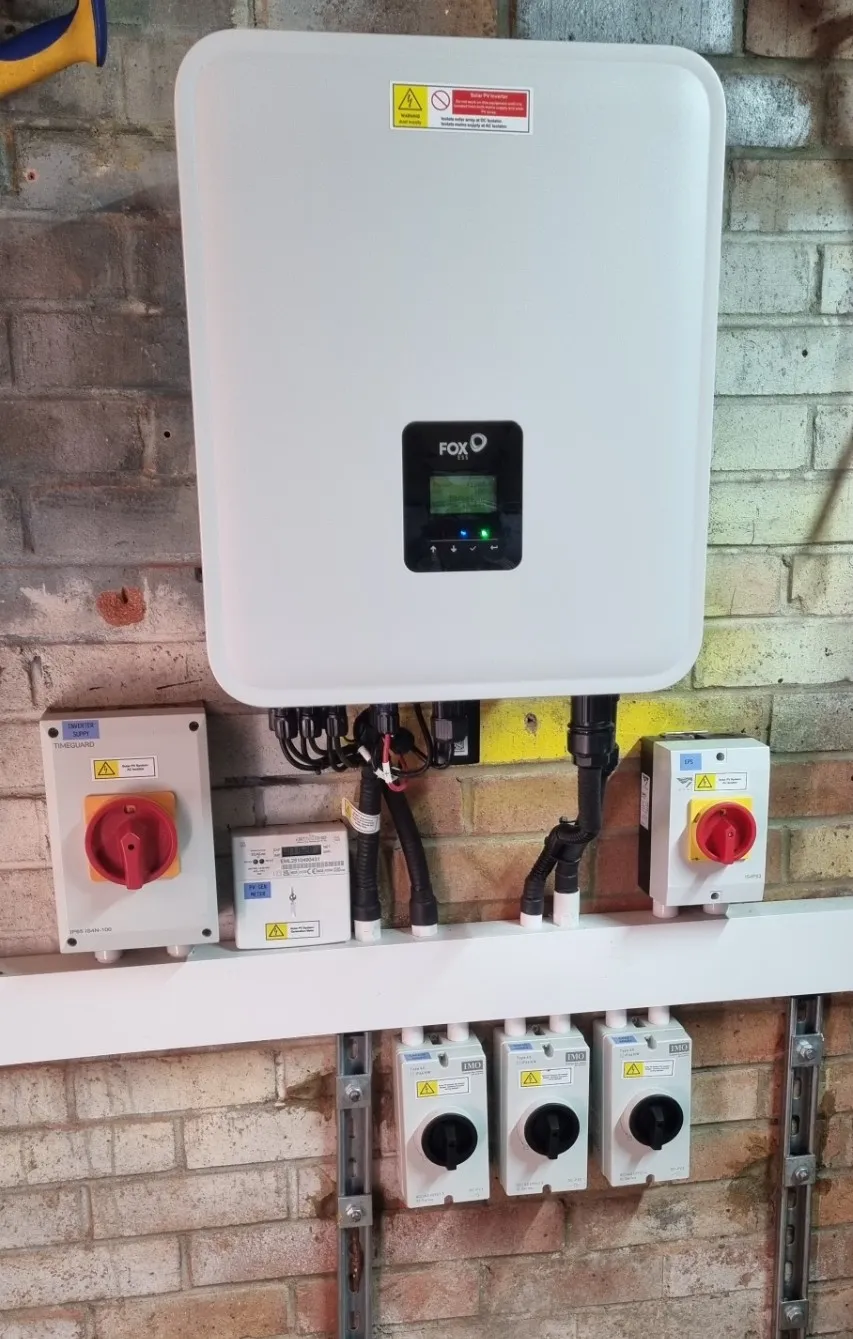

Bespoke PV designs solar PV, battery storage and EV charging systems across Hampshire, Dorset and the South Coast.
Bespoke solar PV, battery storage and EV charging systems for Southampton homes and businesses, designed around roof space, usage and future energy plans.
Solar panels in Southampton →Bespoke solar PV, battery storage and EV charging systems for homes and businesses across Winchester and Hampshire.
Solar panels in Winchester →Solar PV, battery storage and EV charging systems for homes and businesses across Portsmouth and the South Coast.
Solar panels in Portsmouth →Solar PV, battery storage and EV charging systems for homes and businesses across Bournemouth and the South Coast.
Solar panels in Bournemouth →Bespoke PV designs solar PV, battery storage and EV charging systems across Hampshire, Dorset, Wiltshire and the South Coast.
Speak with Bespoke PV about designing a battery system around your tariff, usage pattern, backup needs and future energy plans.