
Commercial Solar Feasibility Guide: Is Solar Right for Your Business?
If your business has a roof and an electricity bill, solar may be worth exploring. The opportunity is usually strongest when the building can support a suitable installation and your operations can use the electricity it produces. You do not need to know the right system size, whether to add a battery or how the grid application works before starting. This guide explains those decisions in plain English, with examples of how different businesses might approach them.
Key Takeaways
- Solar can serve your business directly without a battery.
- Daytime demand often matters more than the annual electricity total alone.
- Flat and pitched roofs can both work when condition, structure and layout are suitable.
- A restricted export connection does not automatically rule out a useful project.
- The right size and investment case come from your own site data and operating plans.
When Commercial Solar Is A Good Fit
Commercial solar is often a useful option for premises with a suitable roof, regular electricity demand during daylight hours and a plan to keep using the building over the longer term. Offices, workshops, manufacturing premises and refrigerated buildings can all have a role for solar, although their best designs may look quite different.
Solar panels generate electricity from daylight. An inverter converts that electricity into a form your building can use. When solar meets part of your demand, you buy less electricity from the grid at that moment. When your demand is higher than generation, the grid continues supplying the difference. You do not have to choose between solar and a normal grid supply.
A large roof on its own is not enough to establish a worthwhile project. An almost empty warehouse may have room for many panels but little demand to serve. A smaller workshop with equipment running throughout the day may use a greater proportion of its generation directly. The question is how the building and the business work together.
An older roof, a short lease or limited daytime activity does not necessarily end the conversation. It may change the size, timing or ownership arrangements of the project. Feasibility means working through those points before you commit. Our commercial solar service brings the building, energy use and future plans into the same design discussion.
For a broader introduction to the technology and its applications, see our solar panels for businesses guide.
Three Signs Worth Exploring
Regular Daytime Demand
Equipment, lighting, cooling or office activity create opportunities to use electricity while it is generated.
A Roof With A Useful Future
A suitable roof and a realistic period of occupation give the installation a practical home.
A Clear Business Objective
Reducing imported electricity, supporting electrification or using an existing asset helps guide the design.
Bespoke PV Insight
Start with how your premises work. Choosing panels first can miss the more useful question: what should the installation do for your business? A good design connects generation to your operations, your building and your plans.
How Your Electricity Use Shapes The Opportunity
The most helpful first step is to understand when your business uses electricity. Annual consumption tells us the scale of demand; the daily pattern shows how much of it solar might serve. Your bills, operating hours and any available interval data provide the starting picture.
For example, a weekday office uses lighting, computers and cooling during much of the solar generation period. That creates an opportunity for direct use on working days. At weekends, the same array may produce a surplus because fewer people are in the building. A model based only on a busy weekday would miss that difference.
A refrigerated warehouse may have demand throughout the day and night. Solar can serve part of its daytime requirement, but it will not produce electricity overnight. An evening-led venue has another pattern: much of its demand may arrive after generation has fallen. Export, a smaller array or a suitable battery may then have a more important role.
Baseload simply means demand that continues when the main operation is quiet, such as refrigeration, servers or security systems. A demand peak is a short period when a lot of equipment runs together. The distinction matters because a brief peak does not justify an array that produces surplus electricity for much of the day.
Seasonal changes matter too. Solar output is generally lower in winter, while electric heating may increase demand. Production shutdowns and holiday closures also belong in the comparison. The aim is an annual picture of your real operation, rather than a prediction based on one convenient day.
Visual Guide: Operating Hours And Solar
You Can Start Without Half-Hourly Data
Half-hourly data records electricity consumption in half-hour periods. It is useful because it reveals daytime use, overnight demand and quiet periods that monthly bills hide. Your supplier or meter-data provider may be able to make it available.
If you do not have it, an initial discussion can still begin with bills and your operating schedule. A stronger model may need additional data or temporary monitoring where timing could change the recommended size or battery decision. Our half-hourly data guide explains the next steps.
The records should describe the area the solar will actually serve. Separate tenant meters cannot simply be added together as though they were one supply. A period containing an extended closure should also be identified, so an unusual year is not mistaken for normal trading.
What Makes A Commercial Roof Suitable?
Both flat and pitched commercial roofs can accommodate solar when their condition, structure and layout are suitable. Roof type affects the mounting approach; it does not, by itself, determine whether solar will work. Orientation, pitch and shading affect generation, while rooflights, plant and access requirements affect the usable space.
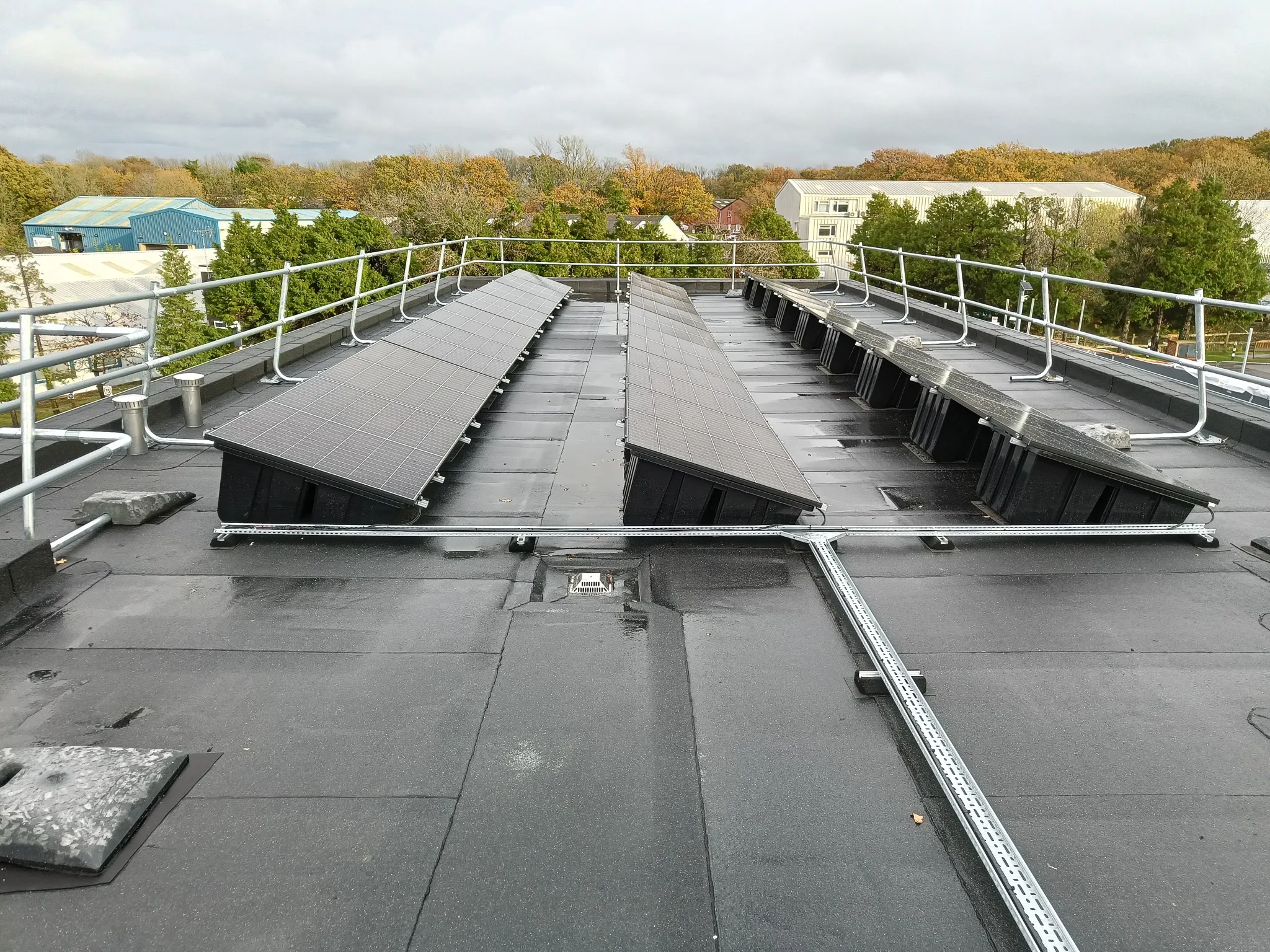
A flat roof may use a ballasted or mechanically fixed mounting system, depending on the building and the engineered design. Ballast avoids some roof penetrations, but adds weight and still needs assessment of loading, wind and the roof covering. A non-penetrating system is therefore an option to investigate, rather than a shortcut around structural checks.
The roof does not need to face due south for the conversation to be worthwhile. East- and west-facing layouts can spread generation into different parts of the day. Whether that is useful depends on the roof geometry, shading and when your business uses electricity. The layout should be modelled rather than accepted or rejected on compass direction alone.
Roof condition can change the best timing. If refurbishment is already approaching, coordinating it with solar may avoid installing equipment that soon has to be removed for roof work. The assessment should identify remaining roof life and any work needed before installation.
Your practical starting point is the building address, any roof drawings or condition reports, and known plans for refurbishment. You do not need to inspect the roof yourself. Our commercial roof assessment guide explains what a suitable review covers.
Visual Guide: Roof Area And Usable Space
Keeping The Building Usable
Maintenance routes, drainage access and working space around roof plant are part of the layout. Leaving them clear helps the roof and the equipment remain manageable after installation. Delivery access, scaffolding or lifting arrangements also influence how work fits around your operations.
The Small Dole commercial installation is an example of solar on a commercial flat roof with non-penetrating mounting. It illustrates one approach; another building may need a different arrangement because its structure, covering and exposure are different.
Electrical Infrastructure And The Grid Connection
Solar connects to your electrical installation through inverters, cabling and suitable protection. The feasibility review establishes a connection point, checks the relevant boards and switchgear, and identifies any supporting work. A long cable route or an awkward equipment location can affect cost and disruption even when the roof itself is straightforward.
Inverters need an appropriate location that is accessible for servicing and suitable for the equipment's environment. Monitoring is also worth planning early: it lets you see generation, grid imports and exports, and how the system is operating after commissioning. These are useful parts of the project scope, rather than details to leave until installation.
Your Distribution Network Operator, or DNO, operates the local electricity network. Grid-connected generation must follow the relevant connection process. G98 covers qualifying small installations; G99 applies outside that scope. The installer establishes the route for the complete proposal, including relevant existing generation and storage, and coordinates the required application or notification.
You do not need to interpret these standards yourself. What you need from the proposal is a clear explanation of the connection route, the requested export, any outstanding response and whether network works could affect the budget or programme. Our DNO and export-limits guide explains those decisions in more detail.
An Export Limit Does Not Automatically Rule Out Solar
An export limit caps what the site can send into the network; it is not necessarily a cap on the electricity the building can use from solar. An agreed export limitation scheme can adjust output to stay within the permitted limit. When demand falls and there is no other use for surplus energy, some generation may be reduced, or curtailed.
That means a busy daytime site can still have a useful solar opportunity with limited export. A quiet site relying heavily on export may be affected more. The model needs to show the expected effect, and the DNO still needs to accept the connection arrangements. National Grid's export-limitation guidance explains one operator's process.
Permission to export and payment for exported electricity are separate arrangements. The financial model should not assume that network consent automatically creates an export income.
How The Right System Size Is Chosen
The recommended size comes from combining four things: useful electricity demand, usable roof space, the electrical installation and the permitted grid connection. It is not chosen by covering every available part of the roof, or by matching annual generation to the total on your bill.
Two measurements help make proposals easier to read. Kilowatt-peak, or kWp, describes the panels' rated capacity under standard test conditions. Kilowatt-hours, or kWh, measure the energy generated or consumed over time. Rated capacity is not a promise that the system will deliver that power continuously; daylight, weather and site conditions change its output.
Consider a weekday workshop with low weekend demand. A smaller array might use a high proportion of its output on site. Adding more panels might still reduce total imports, but could also create more weekend surplus. The worthwhile choice depends on the additional installation cost and what happens to that extra electricity.
Now consider a business with a firm plan for daytime fleet charging. A larger option may have a clearer role because vehicles will add demand while solar is producing. That future scenario should be shown separately from today's demand, so you can see how much the recommendation relies on the plan happening.
A useful proposal compares credible capacity options and explains the recommendation. Our commercial system-sizing guide takes that comparison further.
A Smaller Array And A Larger Array
These are possible trade-offs, rather than a rule that one size is always better.
Smaller Array
- May keep more generation within daytime site demand
- Can leave roof space for a later stage
- May offset less imported electricity overall
Larger Array
- May offset more imported electricity overall
- May create more surplus on quiet days
- Needs a useful, modelled destination for the extra generation
What Happens To The Electricity You Generate?
Solar electricity can meet demand on site, charge a suitable battery or be exported where permitted. If demand exceeds the available solar output, you still import electricity from the grid. If generation exceeds demand, the surplus needs somewhere to go; otherwise output may be reduced.
Using solar directly is called self-consumption. It reduces the electricity you would otherwise import at that time. The financial benefit depends on the charges that actually fall under your contract. Standing charges and other fixed costs do not disappear simply because grid consumption is lower.
Export has a separate value, determined by the relevant commercial arrangement. It may be worthwhile, but its value should not be treated as identical to avoided imports. Similarly, putting electricity through a battery involves losses, so the model should account for the energy that can actually be used later.
In practice, every unit of generation should have one destination in the model. The same electricity cannot both offset an import and earn an export payment. Showing direct use, storage, export and curtailment separately makes a proposal easier to understand and helps prevent savings being overstated.
Visual Guide: Solar Electricity Around Your Site
Battery Storage Is Optional
No, you do not need a battery simply to install commercial solar. Panels can supply electricity directly to your business without storage. If your daytime demand already absorbs much of the generation, solar alone may be the clearer starting point.
A battery becomes more interesting when there is a defined job for it. For example, a business working into the evening might store some daytime surplus for later use. Storage may also support particular demand-management or tariff strategies. Those benefits depend on operating patterns, the electricity contract and the battery's capabilities, rather than on adding storage automatically.
Battery capacity and battery power are different. Capacity, measured in kWh, describes how much energy it can store. Power, measured in kW, describes how quickly it can charge or discharge. A battery may have enough stored energy for a load yet lack the power to supply it all at once. Both measurements matter when comparing options.
A battery also has losses, operating limits and costs over its life. Compare the solar-only proposal with the additional cost and benefit of storage. This makes it clearer whether storage improves the project now, or whether it is sensible to allow for it later.
Power-cut backup needs its own design, controls and supported loads. A standard grid-connected solar and battery installation should not be assumed to keep the whole site running during an outage. Our commercial battery storage page explains the wider planning options.
Understanding Cost, Savings And Payback
There is no reliable fixed price or payback period for every commercial site. The installed scope and the way you use the electricity both change the result. A straightforward roof with an accessible connection point is a different project from one needing roof work, difficult cable routes or network reinforcement.
Bespoke PV explains the main cost areas within the proposal: panels and inverters, mounting, access, electrical works, connection requirements, commissioning and documentation. If roof refurbishment is needed, its scope should be clear too. Our commercial solar cost guide explains why equipment prices alone are not a complete budget.
Savings come from avoided electricity purchases and any export income, less relevant ongoing costs. Regular daytime demand can strengthen the case because more generation has an immediate use. Higher installation costs, extended closures or substantial curtailment can weaken it. The assessment turns those factors into a site-specific comparison, without promising a generic return.
Simple payback asks how long the upfront cost takes to be recovered through net benefits. A short first-year calculation can be useful, but electricity prices, maintenance and equipment replacement may change later cash flows. A full model shows those assumptions and the period being assessed.
The assessment can also show the effect of changes that could alter your decision: lower direct use, different import or export values, and future loads arriving later than planned. That gives your finance team a clearer view of how dependent the proposal is on each assumption. Our ROI and payback guide explains the modelling approach.
What The Investment Measures Mean
| Measure | Plain-English Meaning |
|---|---|
| Simple payback | How long it takes net benefits to recover the upfront investment under the stated assumptions. |
| Lifetime savings | The accumulated benefit over the chosen period, allowing for relevant operating and replacement costs. |
| Net present value (NPV) | Future net cash flows expressed in today's terms at the selected discount rate, including the initial investment. |
| Internal rate of return (IRR) | The discount rate at which the project's NPV becomes zero, where the cash-flow pattern makes it useful. |
Making The Financial Picture Clear
Bespoke PV brings the project cost and energy forecast together in a proposal that explains the main assumptions. That includes the electricity used directly, exported, stored or curtailed, alongside relevant maintenance, degradation and replacement costs. You can see where the expected benefit comes from without building the model yourself.
Your finance team can then consider tax, VAT, funding terms and the business's investment criteria. Where finance is involved, the underlying energy benefit and the payment schedule are distinct parts of that discussion. The solar assessment gives that decision a clearer technical and energy basis.
Planning For EV Charging And Future Demand
You can plan for future energy use without installing every component at once. A staged project might start with solar, reserve a suitable battery location and consider cable routes for chargers. The important part is checking what expansion would require, rather than relying on a general claim that the system is future-ready.
EV charging creates the closest link with solar when vehicles are present during generation hours. Workplace vehicles parked through the day may provide that opportunity. A fleet returning mainly in the evening has a different pattern, so solar, grid imports and any storage need to be considered against its duty cycle. Our commercial EV charging service can be planned alongside the solar review.
Electric heating, refrigeration upgrades, new machinery and longer shifts can also change demand. Heating may increase winter consumption when solar output is lower. Solar is therefore part of the wider supply picture, rather than a dependable replacement for grid capacity whenever equipment needs to run.
The useful outcome is a plan showing what works for today's operation, what changes under confirmed future loads and what infrastructure could sensibly be allowed for now. Firm plans and possible ambitions should remain separate, so the current investment does not rely on demand that may never arrive.
What Happens In A Feasibility Assessment?
You can start with recent electricity bills, the site address, operating hours and your plans for the premises. Roof reports, drawings and interval data are helpful if available, but you do not need a complete technical file before the first conversation. The initial review identifies which missing information would make a difference.
The site assessment then brings together roof suitability, electrical arrangements, access and grid requirements. Ownership matters too. If you lease the premises, landlord permission and the remaining lease need consideration. Where several businesses share a building, the supply and ownership arrangement needs to be clear before savings are allocated.
The design stage compares appropriate system options against demand, generation and connection assumptions. It considers storage where there is a useful role and shows the cost scope and investment case. The recommendation should explain why the chosen option fits your business.
There are three useful outcomes: proceed towards detailed design; resolve an outstanding issue, such as structural evidence or a network response; or revise the project's size, scope or timing. An assessment can still be valuable if it shows that the original idea should change. You should leave knowing the next decision and what information supports it.
Visual Guide: From First Review To A Proposal
The Role Of Bespoke PV
Bespoke PV guides commercial solar from the initial conversation through assessment, tailored design, installation, commissioning and handover. We bring the building, electricity use and future plans together, explain the options and develop a proposal around the business. You do not need to choose the equipment, calculate the array size or prepare a technical specification before getting in touch.
Your knowledge of daily operations and business priorities gives the design its context. The project team handles the technical assessment and explains any specialist input, permissions or connection conditions needed. The aim is a clear process with an understandable recommendation at each stage.
If you are considering commercial solar, speak with Bespoke PV. You can start with the information you have and the goals you want to achieve; we help turn that starting point into a practical proposal.
Commercial Solar Feasibility Guide: Is Solar Right for Your Business? FAQs
Answers to common questions about this guide and related renewable energy planning.
What information is needed for a commercial solar feasibility study?
You can begin with the site address, available electricity bills and a conversation about operating hours and future plans. Bespoke PV explains which further records would help and guides the assessment. You do not need to gather every technical detail or prepare a specification before getting in touch.
Learn more about Commercial Solar Feasibility Guide: Is Solar Right for Your Business? →
Can commercial solar be assessed without half-hourly data?
Yes. Bills and knowledge of operating hours can support an initial review. Half-hourly data gives more detail about when electricity is used. Bespoke PV can guide access to available records and explain any additional data or monitoring that would improve the design.
Learn more about Commercial Solar Feasibility Guide: Is Solar Right for Your Business? →
Does commercial solar always require DNO approval?
Grid-connected solar must follow the relevant connection process. Some qualifying small installations use a notification route; others need an application and approval before connection. Bespoke PV can guide the process and coordinate the technical information for the complete system. Restricted export does not automatically rule out useful solar.
Learn more about Commercial Solar Feasibility Guide: Is Solar Right for Your Business? →
Should battery storage be included with commercial solar?
No. Commercial solar can supply the business directly without a battery. Storage may help move daytime surplus into later operating hours or serve another defined need. Bespoke PV can assess its additional cost and benefit alongside solar alone and explain whether it fits the project.
Learn more about Commercial Solar Feasibility Guide: Is Solar Right for Your Business? →
How is a commercial solar system sized?
The recommended size reflects electricity demand, usable roof space, the electrical installation and connection requirements. Bespoke PV brings those factors together, considers credible future plans and explains why the proposed capacity fits the business. The customer does not need to calculate the array size themselves.
Learn more about Commercial Solar Feasibility Guide: Is Solar Right for Your Business? →
In Summary
Commercial solar is most useful when its design reflects your building and the way your business operates. Bespoke PV brings electricity use, roof suitability, connection requirements and future plans together, then explains suitable options and the investment case. You can begin with the information you have; we guide the assessment and help make the next step clear.
Further Reading
Explore related Bespoke PV articles covering this topic in more detail.

Related Installations
Explore renewable energy systems designed and installed by Bespoke PV.
Planning a renewable energy system?
Speak with Bespoke PV about solar PV, battery storage and long-term energy planning.