EV Charging
Can significantly increase overnight and daily electricity demand.

Home electricity demand is changing. EV charging, heat pumps, electric cooking, hot water, solar export tariffs and backup power can all affect battery sizing. But future-proofing does not always mean buying the largest battery today.
It is sensible to think about future electricity demand when choosing a battery storage system.
Many homes will use more electricity in future as heating, transport, cooking and hot water become more electric.
However, that does not mean every homeowner should simply install the largest battery possible from day one.
Oversizing can increase upfront cost before the additional capacity is needed.
Undersizing can leave the system struggling when new electrical loads are added later.
The best approach is to design a system that works well today while leaving sensible room for tomorrow.
Can significantly increase overnight and daily electricity demand.
Can increase winter electricity use and change seasonal patterns.
Can add high-power household loads.
May require reserve capacity and higher inverter output.
A battery system is a long-term investment.
If it is designed only around the home’s current electricity usage, it may become less suitable once new electrical loads are added.
For example, a household that currently uses modest electricity may later install an EV charger, heat pump or electric hot water system.
Those changes can increase both total energy consumption and peak power demand.
A battery that was well matched to the property at the time of installation may then feel limited.
This does not mean the original design was wrong, but it does show why future plans should be discussed before choosing the battery and inverter.
A household may currently use a modest amount of electricity each day and only need a relatively small battery to cover evening demand and peak-rate imports.
However, that same home may look very different after adding an EV charger, heat pump or electric hot water system.
The battery that appears comfortably sized today may later have to support higher daily consumption, greater evening demand and more complex tariff optimisation.
This does not automatically mean the battery should be oversized from day one.
It does mean the system should be designed so future loads can be added without forcing an unnecessary replacement of the inverter, battery platform or electrical layout.
The opposite mistake is assuming that the largest battery is automatically the best choice.
A very large battery may add cost without delivering proportional savings if the extra capacity is rarely used.
If future EV charging, heat pump installation or solar expansion is several years away, paying for all the capacity today may not be the best use of budget.
Battery storage technology, pricing and product options may also change over time.
In some cases, a modular or expansion-ready system can be more sensible than installing all future capacity immediately.
Future-proofing can be achieved in different ways.
Electric vehicles can have a major impact on household electricity demand.
However, an EV does not automatically mean the home battery needs to be huge.
In many homes, the EV may charge directly from a low-cost overnight tariff rather than from the home battery.
In other cases, the battery may help avoid peak-rate imports, support household demand while the EV charges, or store solar generation for later use.
The best design depends on how often the vehicle is charged, when it is at home, what tariff is used and whether solar panels are installed.
If EV charging is planned, the battery system should be designed with the wider charging strategy in mind.
It is important to avoid treating the home battery as if it must fully charge the car.
Most EV batteries are much larger than typical home batteries.
Trying to size a home battery to regularly charge an EV can make the system unnecessarily expensive.
Instead, the home battery is often better used to manage household demand, avoid expensive import periods, capture surplus solar and improve tariff flexibility.
The EV can then be charged directly from the grid, solar generation or a combination of both, depending on the tariff and system design.
Heat pumps can also change battery sizing.
Unlike EV charging, which may be more flexible in timing, heating demand often increases during colder periods when solar generation is lower.
This can make winter energy strategy more important.
A battery may help shift low-cost electricity into more expensive periods, but it may not be practical or economical to size the battery to cover all heat pump demand.
For heat pump homes, inverter power, charge rate, tariff structure and winter usage patterns may be just as important as total battery capacity.
Future electrification is not limited to EVs and heat pumps.
Electric cooking, immersion heating, hot water cylinders, air conditioning, home offices and additional appliances can all affect household demand.
Some of these loads may use a lot of energy over time.
Others may create short periods of high power demand.
This distinction matters because battery capacity and inverter output solve different problems.
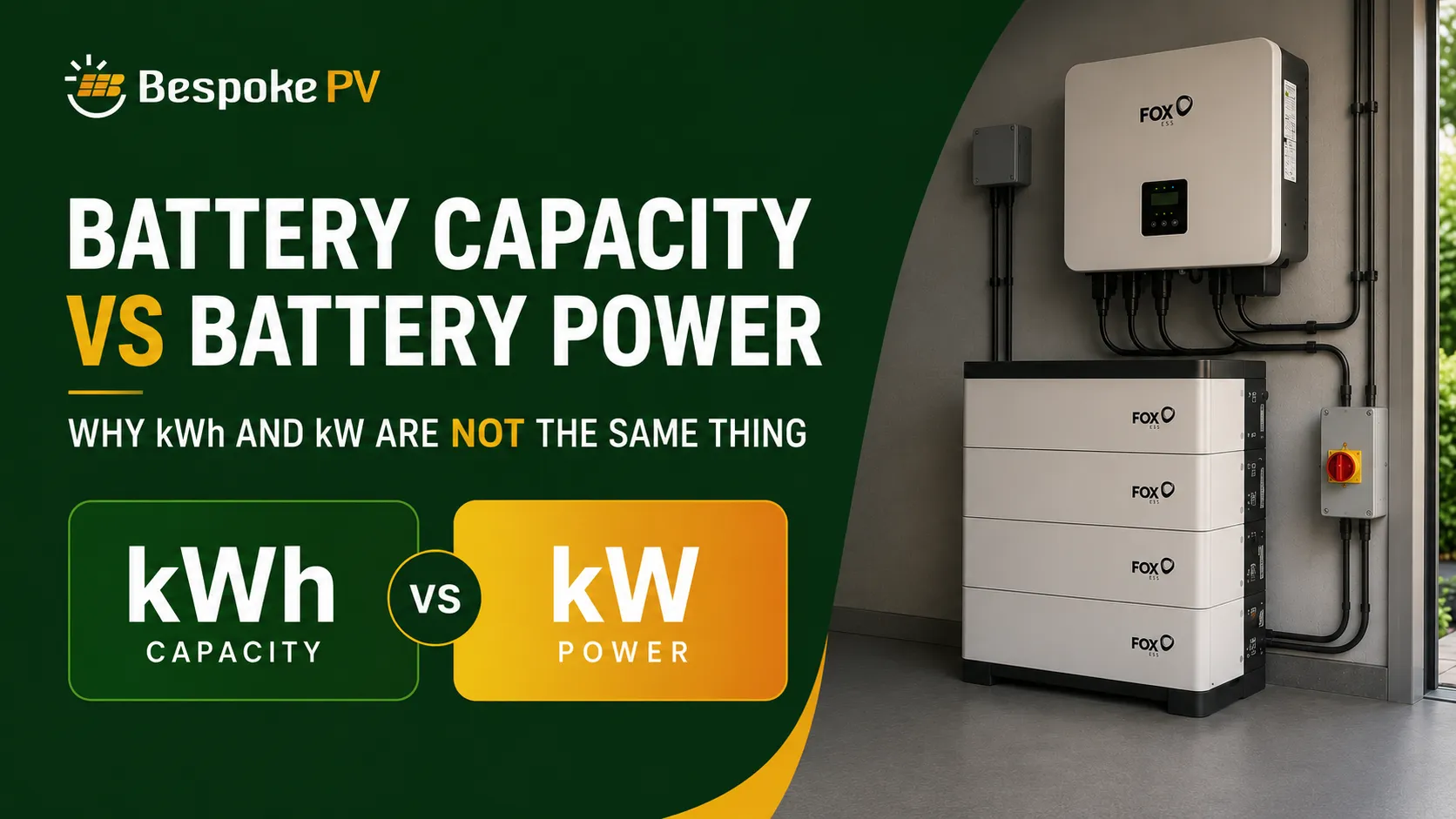
Capacity helps with how long the battery can supply energy. Inverter output affects how much demand the battery system can support at one time.
Electrification affects both how much energy is used and how quickly it is used.
When planning for future electrification, many homeowners focus on battery capacity first.
However, inverter size can be just as important.
A larger battery does not automatically allow the home to run more appliances at the same time.
If the inverter output is too limited, the home may still import from the grid during high-demand periods even when stored energy remains in the battery.
This becomes more important as homes add EV chargers, heat pumps, electric cooking and larger household loads.
A future-ready battery system should therefore consider inverter power as well as battery capacity.
Future-proofing should not be reduced to a simple question of battery size.
The right design considers battery capacity, inverter output, charge rate, discharge rate, tariff structure, solar generation, backup requirements and the homeowner’s future plans together.
Future electricity demand often goes hand in hand with smart tariffs.
A home with an EV, heat pump or battery storage may be able to benefit from lower-cost charging windows.
However, the battery must be able to charge quickly enough to make use of those windows.
If the low-cost period is short and the battery charge rate is limited, a larger battery may not fill before the tariff changes.
Similarly, if the battery cannot discharge quickly enough, the home may still import during high-demand periods.
This is why future-ready design should consider battery power as well as capacity.
Not every future-ready system needs a very large battery.
If the chosen tariff provides multiple low-cost charging windows during the day, the battery may be topped up more than once.
This can reduce the need to store enough energy from a single overnight charge to cover the entire day.
A smaller battery with good charge and discharge capability may sometimes perform better than a much larger battery that charges and discharges slowly.
Tariff structure should therefore be considered before deciding how much extra capacity is needed.
Solar panels can reduce the pressure on battery capacity.
If solar generation is available during the day, it can supply household loads directly and may help recharge the battery before evening demand increases.
This can make a smaller battery more effective than it would be in a battery-only installation.
However, larger solar arrays can also create more surplus generation, especially in spring and summer.
In that case, additional battery capacity may help store more solar energy or shift export into higher-value periods if the export tariff rewards timing.
The best design depends on the relationship between solar generation, household demand, import tariffs and export tariffs.
Solar changes how battery capacity is used.
If solar panels are installed, export tariffs can influence battery sizing.
With a flat export tariff, surplus solar receives the same value whenever it is exported.
If that export rate is attractive, it may not always make sense to oversize the battery simply to avoid exporting solar energy.
With time-of-use or agile-style export tariffs, the battery may have an additional role.
It can potentially store solar energy and export it later during higher-value periods.
In that scenario, extra capacity may be easier to justify if it creates enough additional value.
Battery sizing should therefore consider both import savings and export opportunity.
Battery oversizing is usually difficult to justify when the extra capacity has no regular job to do.
However, tariff and export strategy can change that calculation.
A larger battery may become more useful if it can create value in several different ways: charging from low-cost import periods, avoiding high-cost import periods, storing surplus solar generation, maintaining backup reserve and exporting energy during higher-value export windows.
In this situation, the additional capacity may not sit idle. It may be used repeatedly across different parts of the day and across different seasons.
For example, a home with solar panels may generate surplus electricity during the middle of the day. Under a flat export tariff, that surplus may simply be exported immediately at the same rate regardless of timing.
Under a time-of-use or agile export tariff, the value of export may vary throughout the day. If export prices are higher during certain periods, a larger battery may allow more solar energy to be stored and exported later when it is worth more.
This can make extra capacity more attractive than it would appear from import savings alone.
The battery is no longer only reducing electricity bills by avoiding imports. It may also be increasing the value of solar generation by controlling when that energy is exported.
With a flat export tariff, every exported kilowatt-hour receives the same value regardless of when it is exported.
If that export rate is attractive, there may be less financial need to store every surplus unit of solar generation.
In that case, oversizing the battery purely to avoid export may produce diminishing returns.
The homeowner can still receive value from exported solar, even when the battery is full.
Agile or time-of-use export tariffs create a different opportunity.
If export value changes throughout the day, battery storage can potentially shift solar energy from lower-value periods into higher-value export periods.
This can justify additional capacity where the price difference is large enough, the battery can charge and discharge efficiently, and the system can export sufficient power during the high-value window.
However, this should be modelled carefully. If the export price difference is small, the value may be reduced by round-trip battery losses, cycling, export limits or inverter restrictions.
Export tariff structure can affect whether extra capacity is useful.
Battery sizing becomes more complex when both import and export rates vary.
At some times, the best use of stored energy may be to supply the home and avoid importing electricity at a high rate.
At other times, exporting stored solar energy may be more valuable if export rates are unusually attractive and household demand is low.
The battery control strategy should therefore compare the value of using stored energy inside the home against the value of exporting it.
This is especially important for homes with solar panels, battery storage and smart import or export tariffs.
For example, if the home would otherwise import at a high peak rate, self-consumption may be the best use of stored energy.
If the export rate is higher than the import cost being avoided, and the tariff terms allow it, timed export may be more attractive.
The best design considers import prices, export prices, battery efficiency, battery cycling, inverter capacity, export limits and household demand together.
Tariff-driven oversizing can be valuable, but it should not be assumed to work automatically.
A larger battery only helps if the system can use the extra capacity at the right time.
Several factors can limit the benefit.
The battery must be able to charge quickly enough during low-cost import periods or periods of surplus solar generation.
The inverter must be able to discharge or export enough power during high-value periods.
The property may have export limits, DNO restrictions, tariff rules or supplier conditions that affect how much energy can be exported and when.
Round-trip efficiency also matters. Storing energy and using or exporting it later involves losses, so the price difference must be large enough to justify the cycle.
Battery cycling should also be considered. If the system is cycling aggressively for small price differences, the additional wear may not be justified by the financial return.
For this reason, tariff/export-driven oversizing should be based on realistic modelling rather than headline import and export rates alone.
Extra battery capacity is easiest to justify when it has more than one job.
A larger battery may make sense if it supports tariff optimisation, stores surplus solar, enables higher-value export, maintains backup reserve and prepares the home for future electrification.
However, if the extra capacity is only expected to perform one occasional task, the financial case may be weaker.
The best battery size is the one that matches the whole energy strategy, not simply the one that stores the most energy.
If the battery is expected to provide backup power during outages, future sizing changes again.
Some capacity may need to be kept in reserve rather than used for daily tariff savings.
A homeowner who wants essential loads backup may need less reserve than someone expecting whole-home backup.
If future electrification includes heat pumps, EV charging or electric cooking, backup expectations should be discussed carefully.
Extra battery capacity may be justified if resilience is a priority, but inverter power and load management will also be critical.
Extra capacity may be justified for reasons beyond simple bill savings.
A modular battery system can help balance today’s budget with tomorrow’s needs.
Rather than installing the largest possible battery immediately, the homeowner may start with a sensible amount of capacity and leave room for future expansion.
This can be useful where an EV, heat pump or larger solar array is planned but not yet installed.
However, expansion should not be assumed automatically.
The inverter, battery platform, physical location, cabling, available space and manufacturer compatibility all need to be considered at the design stage.
For some homes, the best solution is a staged design.
The first stage might be a battery sized around current household demand and a suitable smart tariff.
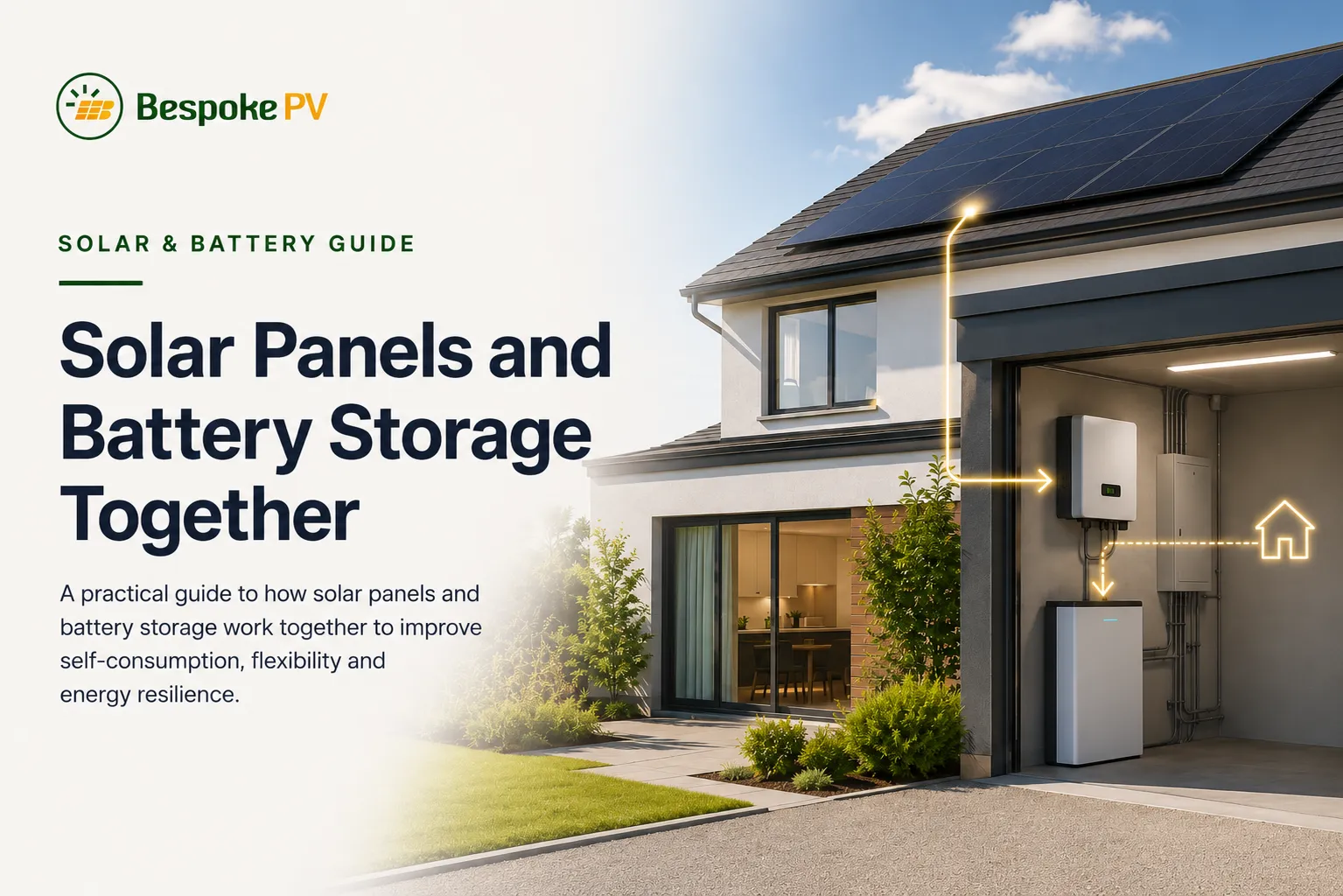
The system could then be installed with an inverter, battery platform, cable routes and physical space that allow extra capacity to be added later.
If the homeowner later installs an EV charger, heat pump or larger solar array, the battery system can be reviewed and expanded if the additional capacity is justified.
This approach can avoid paying for unused capacity too early while still protecting the homeowner from being boxed in by an inflexible initial design.
Leaving room for future expansion is not just a matter of adding another battery later.
The original system should be designed with expansion in mind.
This may affect inverter choice, battery model, installation location, cable routes, wall space, electrical protection, communication wiring and monitoring setup.
It may also affect how the system is documented and how future work can be carried out safely.
A system that is cheap and compact today may become difficult or expensive to expand later if these details are ignored.
A system should not be described as future-ready simply because batteries can theoretically be added later.
Expansion depends on the inverter, battery platform, manufacturer limits, available wall space, cable routes, electrical protection, communication wiring, firmware compatibility and the physical layout of the installation.
Some battery systems allow several modules to be added. Others have stricter limits on the number of batteries, the usable capacity, the compatible models or the maximum charge and discharge rates.
Battery ranges can also change over time. A module available today may not be available in the same form several years later, and future compatibility should not be assumed without checking the manufacturer’s requirements.
Electrical considerations matter as well.
The property’s main fuse, import capacity, export permissions, inverter rating and DNO requirements may all influence whether future expansion is straightforward. Adding battery capacity later may also require changes to protection devices, cabling, monitoring, commissioning settings or certification.
Physical installation space is another common limitation.
If the original battery is installed in a location with no room for additional modules, poor access or limited cable routes, a future upgrade may become more disruptive and expensive than expected.
This is why future expansion should be considered during the original design rather than treated as an afterthought.
A genuinely expansion-ready system should make future upgrades practical, safe and commercially sensible, not merely possible in theory.
Battery systems evolve over time.
A battery module available today may not be available in exactly the same form several years later.
Manufacturers may change models, update communication protocols, alter firmware requirements or introduce new compatibility rules.
This can affect whether future battery modules can be added to an existing installation.
Some systems may require batteries to be from the same product family, similar age range or compatible firmware version.
Others may limit how many modules can be connected to a single inverter or how much usable capacity can be installed in one stack.
This does not mean modular systems should be avoided. It means expansion should be planned realistically and documented properly at the original design stage.
Where future expansion is likely, the chosen battery platform should have a clear upgrade path rather than relying on vague assumptions.
Future-ready battery design is not only about battery modules.
The inverter can become the limiting factor.
If the inverter is too small, adding more battery capacity later may increase storage duration but not improve charge rate, discharge power or export capability.
This can be a problem in homes planning EV charging, heat pumps, electric cooking, whole-home backup or timed export strategies.
A larger battery connected to an undersized inverter may still struggle to support high household demand or make full use of short tariff windows.
This is why inverter sizing should be considered carefully from the beginning.
In many future-ready systems, selecting the right inverter can be more important than installing the maximum battery capacity immediately.
The property itself can also limit future expansion.
Main fuse capacity, import limits, export permissions, consumer unit arrangements, DNO requirements and available electrical infrastructure can all affect what can be added later.
For example, a future upgrade involving more battery capacity, a larger inverter, solar expansion, EV charging or heat pump installation may require additional assessment.
The property may need revised DNO approval, electrical protection changes, load management or alterations to the original installation.
This does not mean expansion is impossible.
It means that future-ready design should consider the wider electrical system, not just the battery datasheet.
A battery system should be designed around how much energy the homeowner may want to store, but also around how much power the property can safely import, export and use.
One of the simplest limitations is also one of the most common: physical space.
A modular battery may be technically expandable, but only if there is suitable space to install additional modules.
Outdoor locations, garages, plant rooms and utility areas should be assessed not only for the first installation but also for future additions.
Safe access, ventilation, manufacturer clearances, cable routes, protection devices and serviceability all matter.
If future modules would block access, breach clearance requirements or require major rewiring, the system may not be genuinely expansion-ready.
For this reason, expansion space should be deliberately allowed for during the first installation where future capacity is likely.
A genuinely expandable system needs more than a modular product brochure.
A future-ready battery system should be designed around realistic next steps.
That might include adding more battery modules, installing solar panels, upgrading to an EV charger, fitting a heat pump, increasing inverter capacity, supporting backup power or optimising export tariffs.
The design should identify which of these are likely, which are possible and which are unlikely.
It should then make sensible provisions for the likely upgrades without adding unnecessary cost for every possible future scenario.
This may include choosing an expandable battery platform, selecting an appropriately sized inverter, leaving physical space for future modules, planning cable routes, considering DNO implications and ensuring the system can be controlled flexibly.
Future-ready design is not about promising that anything can be added later.
It is about making the most likely future upgrades easier, cleaner and more cost-effective.
Future electrification can also place greater demands on the property’s electrical supply.
EV chargers, heat pumps, batteries, solar inverters and export capability may all need to be considered in relation to the property’s connection, main fuse, import capacity and export permissions.
This does not mean every home needs major electrical upgrades.
It does mean that battery design should consider the wider electrical picture.
A future-ready system should not only ask how much energy the homeowner wants to store, but also how much power can safely and practically move through the property.
There is a risk in doing too little at the start.
If the original system is sized tightly around today’s usage with no thought for expansion, future upgrades may be more difficult.
The homeowner may later find that the inverter is too small, the battery platform is not expandable, the installation location is unsuitable or the system cannot support new loads as expected.
In some cases, this can mean replacing equipment earlier than planned.
Good design can reduce this risk by choosing equipment and layouts that support realistic future options.
There is also a risk in overcommitting too soon.
Installing a much larger battery than the home currently needs can increase upfront cost and extend payback.
If the future loads are uncertain, delayed or smaller than expected, some of the extra capacity may sit underused for years.
The best solution is usually not blind oversizing.
It is careful design that identifies which future changes are likely, which are speculative, and which decisions need to be made now to preserve flexibility.
There are situations where adding extra battery capacity from the start can be sensible.
If the homeowner already knows that an EV charger, heat pump, electric hot water system, larger solar array or major electrical upgrade is likely in the near future, it may be more efficient to size the battery system around that expected demand from day one.
Oversizing may also be justified where backup power is a key requirement.
If the homeowner wants to maintain a meaningful reserve for power cuts, only part of the battery capacity may be available for daily tariff savings. In that situation, additional capacity can provide resilience without sacrificing too much day-to-day usefulness.
Larger homes with consistently high electricity demand may also make better use of extra capacity because the battery is likely to cycle more regularly.
Tariff strategy can also justify additional capacity. If the home uses agile or time-of-use import tariffs, a larger battery may help capture more low-cost electricity and avoid more high-cost periods. If solar panels are installed and the export tariff varies by time of day, extra capacity may also allow solar energy to be stored and exported later when it is worth more.
The important distinction is whether the extra capacity has a clear job to do.
Oversizing is easier to justify when the future demand is likely, specific and near-term, or when the extra capacity supports backup reserve, tariff optimisation or timed solar export.
It is harder to justify when the future requirement is vague, distant or based only on the assumption that bigger must be better.
Future-proofing starts with understanding the homeowner’s plans.
Battery storage should be viewed as part of a wider home energy plan.
The first stage might be a battery system designed around current electricity use and tariff savings.
The next stage might include solar panels, EV charging, heat pump installation, export optimisation or backup power.
A staged approach can avoid unnecessary upfront cost while still keeping the home ready for future changes.
The important point is that each stage should be planned with the next one in mind.
The best future-ready battery system is not necessarily the biggest system available today.
It is the system that works well now, can adapt to future electrical loads, and avoids locking the homeowner into equipment that limits their options later.
For many homes, that means choosing the right inverter, a suitable battery platform and a design that allows sensible expansion when the time is right.
So, should you oversize battery storage for future electrification?
Sometimes, but not automatically.
Extra capacity can be worthwhile where future loads are likely, backup reserve is important, solar generation is expected to increase or tariff strategy creates additional value.
However, oversizing without a clear reason can add cost and weaken payback.
A better approach is to design around today’s usage, realistic future plans, inverter capability, tariff flexibility, solar potential and expansion options.
Future-proofing is not about buying the biggest battery.
It is about making sure the system can grow with the home.
Explore more Bespoke PV articles covering battery sizing, inverter power, smart tariffs, backup power and future-ready energy design.
Not automatically. Future electrification should be considered, but the best design may be an expansion-ready system rather than simply installing the largest battery today.
Future electrification means the home may use more electricity in future due to EV charging, heat pumps, electric cooking, hot water, air conditioning or backup power requirements.
No. Future-proofing means designing for flexibility and expansion, while oversizing means installing more capacity than is currently needed.
A battery sized only around today's usage may become limited if the home later adds an EV charger, heat pump, larger solar array or other electric loads.
The largest battery may increase upfront cost without delivering proportional savings if the extra capacity is rarely used.
Oversizing can make sense where future demand is likely, specific and near-term, or where extra capacity supports backup reserve, smart tariff optimisation or timed solar export.
Oversizing is harder to justify when future demand is vague, uncertain or distant, and the extra battery capacity has no clear job to do.
Often, yes. An expansion-ready system can reduce upfront cost while allowing extra capacity to be added later if it becomes worthwhile.
No. Expansion depends on the inverter, battery platform, manufacturer limits, available space, wiring, electrical protection and product compatibility.
A genuinely expansion-ready system has suitable inverter capacity, compatible battery options, space for extra modules, planned cable routes and electrical design that supports future upgrades.
Yes. Battery ranges can change over time, so future expansion should consider manufacturer compatibility and the risk that identical modules may not be available later.
Not always. EVs are often charged directly from the grid or solar, while the home battery manages household demand, tariff savings and solar storage.
Usually not. EV batteries are much larger than typical home batteries, so sizing a home battery to regularly charge an EV can become expensive and inefficient.
Yes. A home battery can help manage household demand, avoid peak-rate imports and make better use of solar while the EV is charged separately.
Yes. Heat pumps can increase winter electricity demand and may affect battery capacity, inverter sizing, charge rate and tariff strategy.
Not usually. It may not be practical or economical to size a battery to cover all heat pump demand, especially during winter.
Yes. Electric ovens, hobs and other cooking appliances can create high power demand, so inverter output may be just as important as battery capacity.
Yes. Electric hot water systems can increase energy demand and may influence battery size, tariff strategy and load management.
Inverter size determines how much stored energy can be delivered at one time, which becomes more important as homes add high-demand electrical loads.
Both matter. Battery capacity affects how much energy can be stored, while inverter power affects how much demand can be supplied at once.
Yes. A large battery may contain plenty of energy, but a small inverter can limit how much power the home can use from it at one time.
Charge rate affects how much low-cost electricity or solar energy the battery can store during a limited charging window.
Yes. If the battery can recharge more than once during the day, it may not need to store enough energy from a single overnight charge.
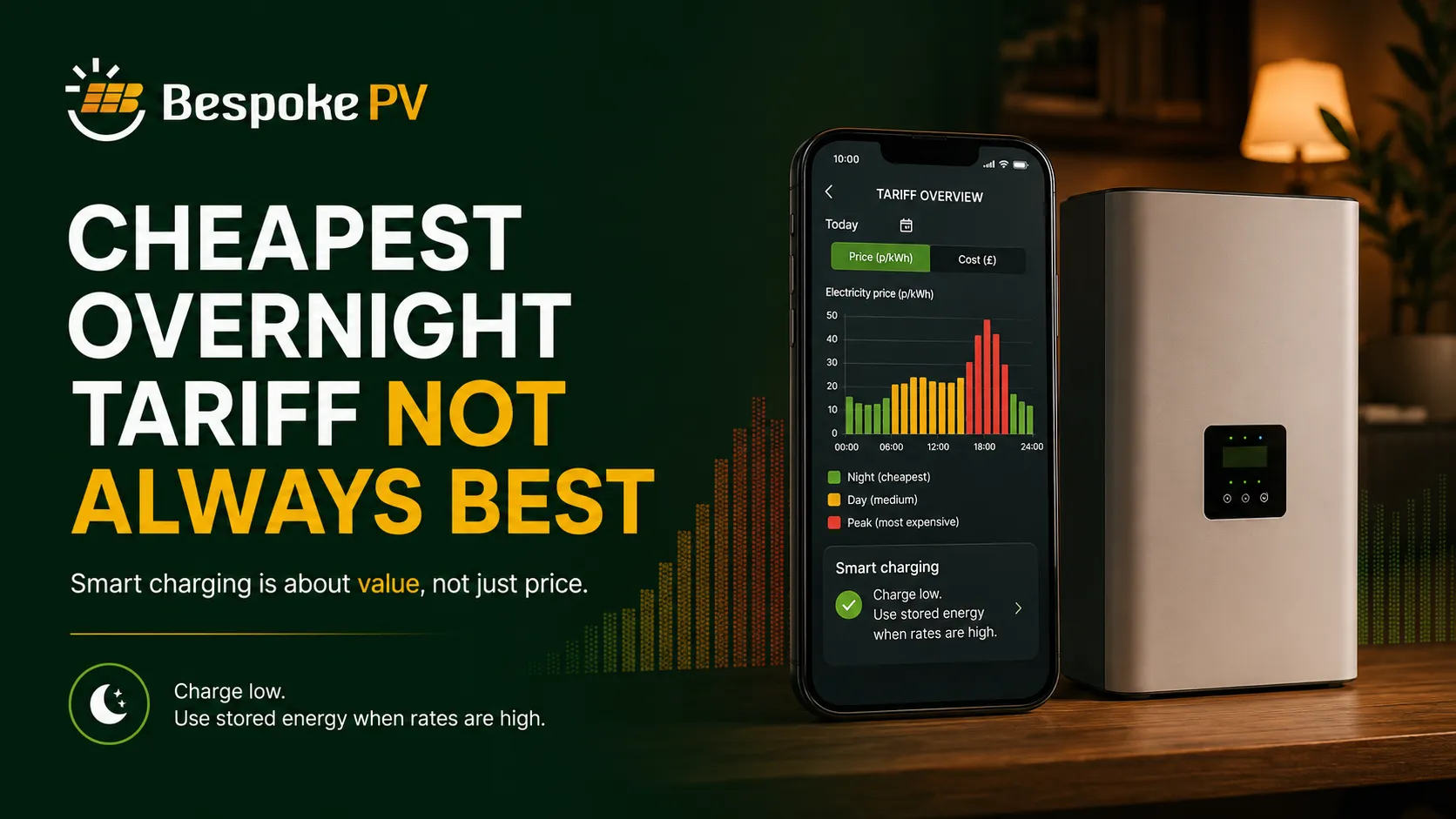
Smart tariffs can affect battery sizing by changing when electricity is cheapest, how often the battery can recharge and how much peak-rate import it needs to avoid.
Potentially, yes. Agile tariffs may create opportunities to store more low-cost electricity, but the value depends on price patterns, battery power and automation.
It can. Solar generation can supply daytime loads and recharge the battery, reducing reliance on stored overnight electricity.
Yes. A larger solar array may create more surplus generation, and extra battery capacity may help store or time-shift that energy.
Yes. Export tariffs can affect whether surplus solar should be exported directly, stored for later use or shifted to higher-value export periods.
Potentially, yes. If export rates are higher at certain times, extra battery capacity may help store solar energy and export it later when it is worth more.
Sometimes. If surplus solar receives a fair flat export rate, oversizing the battery just to avoid export may be harder to justify.
Yes. Backup power may require reserve capacity, meaning only part of the battery is available for everyday tariff savings.
Usually, yes. Whole-home backup can require more capacity, more inverter power and more careful load management than critical loads backup.
Battery reserve capacity is energy deliberately kept available for backup power rather than used for normal tariff savings or solar self-consumption.
Yes. EV chargers, heat pumps, electric cooking and hot water can increase the power and energy demands placed on a backup system.
The system may become difficult or expensive to upgrade later if the inverter, battery platform, cabling or installation location were not chosen with expansion in mind.
Installing too much capacity before it is needed can increase upfront cost and leave part of the battery underused for years.
Yes. Import capacity, export permissions, inverter rating and connection requirements can all affect future battery, solar and EV charging plans.
Yes. The main fuse and available import capacity can affect how quickly batteries, EV chargers and other electrical loads can operate together.
If there is no physical space, safe access or suitable cable route for extra modules, future battery expansion may become difficult or costly.
Yes. Battery expansion may depend on firmware support, manufacturer limits, compatible modules and approved installation configurations.
Ask whether an EV, heat pump, solar expansion, backup requirement, smart tariff strategy or higher future electrical demand is likely and near-term.
Often, yes. A staged plan can avoid unnecessary upfront cost while keeping the system ready for solar, EV charging, heat pumps or extra battery capacity later.
The best size depends on current usage, likely future loads, tariff structure, solar plans, inverter power, backup requirements and whether the system can be expanded later.
Explore related Bespoke PV articles and renewable energy insights.
Explore renewable energy systems designed and installed by Bespoke PV.
Bespoke PV designs solar PV, battery storage and EV charging systems across Hampshire, Dorset and the South Coast.
Bespoke solar PV, battery storage and EV charging systems for Southampton homes and businesses, designed around roof space, usage and future energy plans.
Solar panels in Southampton →Bespoke solar PV, battery storage and EV charging systems for homes and businesses across Winchester and Hampshire.
Solar panels in Winchester →Solar PV, battery storage and EV charging systems for homes and businesses across Portsmouth and the South Coast.
Solar panels in Portsmouth →Solar PV, battery storage and EV charging systems for homes and businesses across Bournemouth and the South Coast.
Solar panels in Bournemouth →Bespoke PV designs solar PV, battery storage and EV charging systems across Hampshire, Dorset, Wiltshire and the South Coast.
Speak with Bespoke PV about designing a battery system around today’s usage, future electrification, smart tariffs, solar generation and backup requirements.